Inventory Audit KPIs: 10 Metrics Every Manager Should Track
| By Stockount
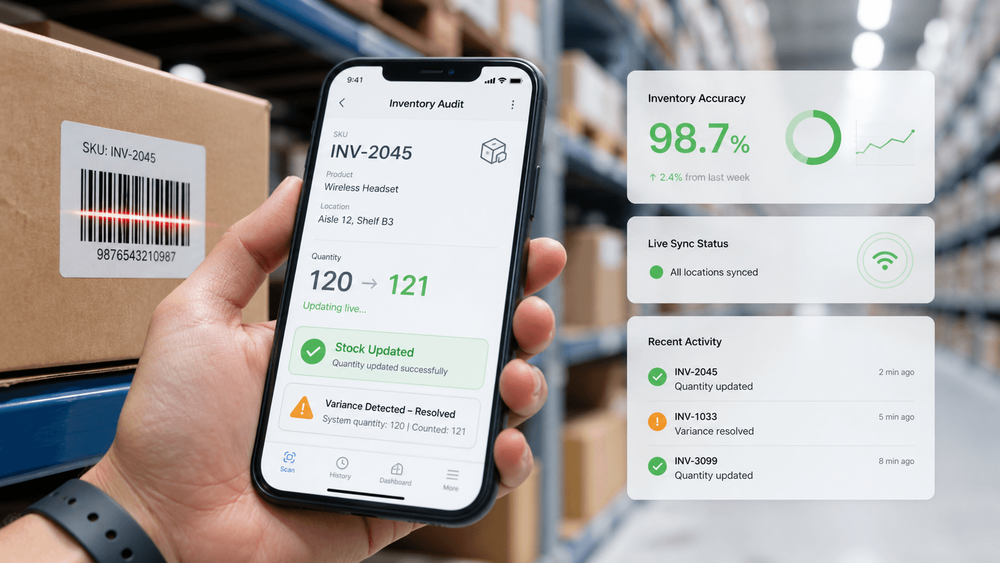
Your inventory reports show 98% accuracy. Your audit tells a different story. Here are the 10 inventory audit KPIs that reveal what the reports miss, and what to do about it.
What Are Inventory Audit KPIs?
Inventory audit KPIs are quantifiable metrics used to measure the accuracy, efficiency, and control of a company's stock management process. They transform audit findings into actionable data that managers can monitor, benchmark, and act on.
The 10 essential inventory audit KPIs are:
- Inventory Accuracy %
- Stock Variance %
- Shrinkage Rate
- Cycle Count Accuracy
- Audit Coverage %
- Discrepancy Resolution Time
- Dead Stock %
- Inventory Turnover Rate
- Order Accuracy Rate
- Real-Time Visibility Score
Why Most Inventory KPI Programs Fail
The average warehouse operation loses 1.6% of inventory value to shrinkage annually but many managers don't discover the scale of the problem until the annual physical count. By then, the damage is done.
Three structural failures drive most inventory KPI breakdowns:
- No real-time tracking. Static, end-of-period reports mask discrepancies for weeks or months. By the time a mismatch surfaces, tracing its root cause is nearly impossible.
- No discrepancy visibility. Teams know variances exist but lack the granular data — by SKU, location, and date — to diagnose and fix them systematically.
- Delayed audits. Annual or semi-annual physical counts create long blind spots. High-velocity SKUs can cycle through dozens of discrepancies between count dates.
Effective inventory audit KPIs solve each of these problems — but only if they're measured continuously, not periodically.
What Makes an Inventory KPI Worth Tracking?
Not every metric belongs on a manager's dashboard. An inventory audit KPI earns its place when it meets four criteria:
- Measurable: Backed by a clear formula and reliable data source.
- Actionable: A variance in the metric points directly to a corrective action.
- Real-time: Updated frequently enough to catch issues before they escalate.
- Revenue-linked: Connected to a tangible cost (carrying cost, lost sales, write-offs).
Every KPI in this guide meets all four criteria.
The 10 Inventory Audit KPIs Every Manager Should Track
KPI 01 — Inventory Accuracy %
The foundational metric of any audit program. Inventory accuracy % measures how closely your system records match physical stock reality. A single percentage point of inaccuracy on a $5M inventory equates to $50,000 in unaccounted stock.
Formula: Inventory Accuracy % = (Items Counted Correctly / Total Items Counted) × 100
| Real-World Example | A 3PL counts 2,450 of 2,500 SKUs correctly → 98% accuracy. |
| Benchmark | ≥ 98% (world-class); 95–97% (acceptable); < 95% = urgent investigation |
Optimization tip: Segment accuracy by SKU velocity. A-class items demand weekly cycle counts; C-class items monthly.
KPI 02 — Stock Variance %
Stock variance analysis quantifies the gap between recorded and actual quantities. Unlike accuracy %, variance tracks magnitude — a 10-unit discrepancy on a 10-unit SKU is catastrophic; the same gap on 10,000 units is noise. Variance directly inflates carrying costs and creates phantom stock.
Formula: Stock Variance % = ((Recorded Qty − Physical Count) / Recorded Qty) × 100
| Real-World Example | System: 500 units. Physical: 487 units. Variance = 2.6% — above the 1% threshold. |
| Benchmark | < 1% (excellent); 1–3% (monitor closely); > 3% = root-cause investigation required |
Optimization tip: Run variance trending by category to spot seasonal patterns — shrinkage often spikes around holiday peaks.
KPI 03 — Shrinkage Rate
Shrinkage rate calculation captures losses from theft, damage, spoilage, and administrative errors. It's the single most revenue-damaging inventory metric for retail and wholesale operations. The NRF Retail Security Survey consistently puts retail shrink above $100B annually in the US alone.
Formula: Shrinkage Rate % = ((Recorded Value − Actual Value) / Recorded Value) × 100
| Real-World Example | $1M recorded value, $982K physical value → 1.8% shrinkage rate. |
| Benchmark | Industry average: 1.6%. Top performers: < 0.5%. > 2% demands immediate audit. |
Optimization tip: Break shrinkage into theft, damage, and admin error categories. Each requires a different corrective playbook.
KPI 04 — Cycle Count Accuracy
Cycle count accuracy measures the precision of your ongoing rolling audit program. Unlike an annual physical count, cycle counting audits rotating subsets of SKUs throughout the year — enabling continuous accuracy without operational shutdowns.
Formula: Cycle Count Accuracy % = (Correct Counts / Total Counts in Period) × 100
| Real-World Example | 240 of 250 SKUs counted correctly in a monthly cycle → 96% cycle accuracy. |
| Benchmark | ≥ 97%. Below 95% means your cycle count methodology needs redesign. |
Optimization tip: Prioritize high-velocity and high-value SKUs in every cycle. Use ABC analysis to set count frequency by tier.
KPI 05 — Audit Coverage %
Audit coverage % tracks what proportion of your total SKU catalog has been audited within a defined period. Low coverage creates blind spots — discrepancies accumulate undetected in uncounted zones. Many operations achieve high accuracy on counted items while leaving 40% of SKUs unchecked.
Formula: Audit Coverage % = (SKUs Audited in Period / Total SKUs) × 100
| Real-World Example | 800 of 1,200 SKUs audited in Q1 → 66.7% coverage. A-class items at 100%, C-class at 40%. |
| Benchmark | A-items: 100% monthly. B-items: 100% quarterly. C-items: 100% annually. |
Optimization tip: Automate coverage tracking by SKU class. Manual monitoring of 10,000+ SKUs is error-prone and unsustainable.
KPI 06 — Discrepancy Resolution Time
Inventory discrepancy tracking isn't complete until discrepancies are investigated and resolved. Resolution time measures how quickly your team closes the loop from discovery to root-cause fix. Unresolved discrepancies compound — a receiving error left open for 30 days can trigger downstream stockouts and mis-shipments.
Formula: Resolution Time = Date Discrepancy Closed − Date Discrepancy Logged
| Real-World Example | A pick-count mismatch logged Monday, root cause found Wednesday, corrected Thursday → 3-day resolution. |
| Benchmark | Critical discrepancies: < 24 hours. Standard: < 72 hours. > 7 days = process failure. |
Optimization tip: Implement automatic escalation alerts when discrepancies exceed 48 hours without action.
KPI 07 — Dead Stock %
Dead stock percentage measures the proportion of inventory that hasn't moved within a defined period (typically 90–180 days). Dead stock ties up capital, consumes storage space, and often depreciates — yet many operations have no systematic way to surface it until an annual count reveals the scale.
Formula: Dead Stock % = (Units With Zero Movement in 90 Days / Total Units On Hand) × 100
| Real-World Example | 3,200 of 28,000 units unmoved in 90 days → 11.4% dead stock. Write-down or liquidation required. |
| Benchmark | < 5% of total inventory. Above 10% signals serious demand planning failures. |
Optimization tip: Set automated 60-day warnings for slow-moving SKUs so teams can act before stock becomes fully dead.
KPI 08 — Inventory Turnover Rate
Inventory turnover metrics reveal how efficiently you're converting stock into revenue. Low turnover means excess capital is trapped in slow-moving inventory; high turnover (without stockouts) means your purchasing and forecasting are well-aligned. This KPI directly links audit performance to financial outcomes.
Formula: Inventory Turnover = Cost of Goods Sold / Average Inventory Value
| Real-World Example | COGS: $4.2M. Average inventory: $840K → Turnover ratio of 5.0 (turns over every 73 days). |
| Benchmark | Retail: 4–6×. Manufacturing: 3–5×. Grocery/FMCG: 12–25×. Always benchmark within sector. |
Optimization tip: Track turnover by SKU category, not just overall. A high average can mask a stagnant product line dragging capital efficiency down.
KPI 09 — Order Accuracy Rate
Order accuracy rate measures the percentage of customer orders fulfilled without errors — right item, right quantity, right location. It's where warehouse KPI metrics connect to the customer experience. A 1% order error rate on 10,000 monthly orders means 100 unhappy customers, 100 return shipping costs, and 100 reprocessing events.
Formula: Order Accuracy % = (Orders Fulfilled Without Error / Total Orders) × 100
| Real-World Example | 9,920 error-free orders out of 10,000 → 99.2% order accuracy. 80 orders require investigation. |
| Benchmark | ≥ 99.5% (world-class); 98–99% (acceptable); < 97% = process redesign required. |
Optimization tip: Cross-reference order errors against inventory accuracy by location. Mis-picks often cluster in high-density storage zones.
KPI 10 — Real-Time Visibility Score (Unique Differentiator)
The Real-Time Visibility Score is a composite metric that most operations don't yet track — but should. It measures the percentage of inventory movements captured and reflected in the system within 60 seconds of occurring. Static reports tell you where stock was; real-time visibility tells you where it is.
Formula: Visibility Score % = (Live-Captured Movements / Total Movements in Period) × 100
| Real-World Example | A warehouse processes 1,200 stock movements daily. 1,140 captured in real-time → 95% visibility score. |
| Benchmark | ≥ 95% for modern operations. < 80% = significant blind spots impacting all other KPIs. |
Why this matters: Every other KPI on this list improves when real-time visibility improves. It's the multiplier metric — low visibility degrades accuracy, inflates variance, and extends resolution time simultaneously.
KPI Dashboard: Sample Benchmark Table
Use this format to build your internal audit scorecard. Update weekly for A-class items; monthly for all others.
| KPI | Target | Industry Avg | Status | Recommended Action |
|---|---|---|---|---|
| Inventory Accuracy % | ≥ 98% | 94–96% | On Track | Maintain weekly A-item cycle counts |
| Stock Variance % | < 1% | 2–3% | Monitor | Investigate receiving process; check supplier short-shipments |
| Shrinkage Rate | < 0.5% | 1.6% | Critical | Conduct zone-by-zone theft/damage analysis immediately |
| Cycle Count Accuracy | ≥ 97% | 93–95% | On Track | Expand cycle count program to B-class items |
| Audit Coverage % | A: 100% monthly | A: 80–90% | Monitor | Schedule missed SKUs; automate coverage tracking |
| Discrepancy Resolution | < 72 hrs | 5–7 days | Critical | Implement 48hr escalation alerts; assign discrepancy owners |
| Dead Stock % | < 5% | 8–12% | Monitor | Flag items at 60 days no-movement; run clearance initiative |
| Inventory Turnover | 4–6× (retail) | Sector-dependent | On Track | Analyze by category; address low-turnover product lines |
| Order Accuracy Rate | ≥ 99.5% | 97–99% | On Track | Cross-reference errors to specific pick zones |
| Real-Time Visibility Score | ≥ 95% | 60–75% | Critical | Implement live-tracking system; eliminate manual log delays |
** Is your scorecard in the red?**
Most operations managers discover critical inventory gaps weeks after they form. Stockount surfaces discrepancies, shrinkage spikes, and accuracy drops the moment they happen — so you can act in hours, not months.
✓ No credit card required ✓ Set up in under 15 minutes ✓ Real-time KPI alerts included
4 Common Inventory KPI Mistakes That Kill Audit Programs
Mistake 1: Tracking Without Acting
Collecting KPI data without a defined response protocol is a reporting exercise, not a management system. Every KPI must have a pre-defined threshold and a corresponding action — otherwise it's decoration on a dashboard.
Mistake 2: Ignoring Root Causes
Correcting a discrepancy without investigating why it occurred guarantees recurrence. Stock mismatch causes — receiving errors, system lag, pick-path confusion — repeat until the system-level issue is resolved.
Mistake 3: No Real-Time Validation
Validating KPIs only at period-end means discrepancies accumulate for weeks. By the time variance surfaces in a monthly report, it's already compound. Real-time inventory visibility is the only way to catch issues at the transaction level.
Mistake 4: Over-Reliance on Manual Systems
Spreadsheet-based auditing introduces human error into the very process designed to catch it. Manual cycle count logging, clipboard-based variance tracking, and email-based discrepancy resolution all create the gaps that inventory audits are meant to close.
Why Real-Time Inventory Tracking Changes Everything
Static reports fail for one fundamental reason: they show you where inventory was at a fixed point in time, not where it is right now. In a warehouse processing 500+ transactions per day, a 24-hour reporting lag means hundreds of movements are invisible to management.
The operational consequences cascade quickly:
- Phantom stock causes over-selling and customer disappointment
- Undetected shrinkage compounds between count dates
- Replenishment triggers fire late, causing stockouts of in-demand items
- Discrepancy resolution is delayed because transaction history is unclear
Real-time inventory tracking — via barcode scanning, RFID, or live-sync WMS integrations — captures every movement at the transaction level. The result: Inventory Accuracy %, Stock Variance %, and Discrepancy Resolution Time all improve simultaneously because the underlying data is current, not historical.
Operations that implement live stock tracking systems with automated inventory alerts typically see:
- 30–50% reduction in shrinkage through faster detection
- 60–70% reduction in discrepancy resolution time
- Inventory accuracy improvements of 3–5 percentage points within 90 days
Stockount's real-time audit dashboard gives operations managers live KPI visibility — from cycle count accuracy to discrepancy queues without waiting for end-of-day batch processing.
Frequently Asked Questions
What is a good inventory accuracy rate?
A good inventory accuracy rate is 95% or higher. Top-performing warehouses typically achieve 98–99%. Anything below 95% signals systemic issues with counting processes, data entry, or shrinkage that require immediate investigation and corrective action.
How do you measure stock variance?
Stock variance is measured by comparing recorded inventory levels against physical counts. Formula: Stock Variance % = ((Recorded Qty − Physical Count) / Recorded Qty) × 100. A variance under 1% is considered healthy; above 3% warrants urgent root-cause investigation.
What causes inventory discrepancies?
Inventory discrepancies are caused by data entry errors, employee theft, supplier short-shipments, damaged goods not recorded, incorrect receiving, miscounts during picking, and outdated manual processes. Real-time tracking and automated alerts catch these issues before they compound.
How often should inventory audits be done?
High-value or fast-moving SKUs should be audited weekly via cycle counts. Medium-velocity items monthly. A full physical inventory count should occur at least annually, with continuous cycle counting filling the gaps throughout the year.
What KPIs improve warehouse efficiency?
The KPIs that most directly improve warehouse efficiency are Inventory Accuracy %, Cycle Count Accuracy, Order Accuracy Rate, Discrepancy Resolution Time, and Real-Time Visibility Score. Together, they reduce waste, improve fulfillment speed, and lower carrying costs.
How does real-time inventory tracking work?
Real-time inventory tracking uses barcode scanning, RFID tags, or IoT sensors connected to a central platform. Every stock movement receiving, picking, transfer, or return, updates the system instantly, giving managers live visib,ility into stock levels, location, and discrepancies.
What is inventory shrinkage and how is it calculated?
Inventory shrinkage is the loss of stock due to theft, damage, spoilage, or administrative error. Formula: Shrinkage Rate % = ((Recorded Value − Actual Value) / Recorded Value) × 100. The retail industry average is 1.6%; anything above 2% requires immediate investigation.
What is the difference between a physical inventory count and a cycle count?
A physical inventory count audits all SKUs simultaneously, typically once per year, causing operational disruption. A cycle count audits a rotating subset of SKUs continuously throughout the year with no shutdown, enabling faster discrepancy detection and less business disruption.
Start With the Right Metrics — Then Automate Them
Inventory audit KPIs aren't just performance checkboxes. They're the operational early-warning system that separates reactive warehouses from proactive ones. The difference between a 1.6% shrinkage rate and a 0.5% rate on a $10M inventory is $110,000 recovered annually, through better measurement alone.
The 10 KPIs in this guide give you the complete picture: from the foundational inventory accuracy percentage to the multiplier metric, real-time inventory visibility score. Track all 10. Assign owners. Set thresholds. Automate alerts.
Key Takeaways:
- Track all 10 KPIs continuously, not just at period-end
- Inventory Accuracy % below 95% requires immediate corrective action
- Real-Time Visibility Score is the multiplier metric — improving it lifts all other KPIs
- Discrepancy Resolution Time above 72 hours signals a process failure, not just a data gap
- Dead Stock above 5% means your demand planning and purchasing are misaligned
- Automate alerts at threshold breaches — manual monitoring doesn't scale
Every day without real-time tracking is a day of compounding loss.
Stop discovering inventory problems after the damage is done
Stockount gives your team live audit KPIs, automated discrepancy alerts, and cycle count tracking — all in one dashboard. Operations that switch from spreadsheets catch issues 60–70% faster.
✓ Free plan available ✓ Live KPI dashboard on day 1 ✓ Integrates with your existing WMS ✓ SOC 2 compliant