Manufacturing Audit: Complete Guide to 99% Stock Accuracy & Real-Time Tracking (2026)
| By Stockount

The average inventory accuracy rate across businesses sits at just 83% , and only 69% of companies even actively track this metric, according to 2024 CAPS Research data. In manufacturing specifically, operations typically lose 1.6% of total sales to shrinkage, with raw materials vanishing somewhere between receiving and the production floor.
That's not a rounding error. For a $10M manufacturing operation, 1.6% shrinkage equals $160,000 lost every year, from miscounts, unrecorded transfers, process waste, and audit blind spots.
Globally, inventory distortion, covering shrinkage, stockouts, and overstock, costs businesses an estimated $1.6 trillion annually. And more than 40% of manufacturers expect their inventories to shrink further in the next 12 months.
Yet most facilities still rely on manual logs, annual full counts, and spreadsheets that go stale the moment they're saved.
This guide shows you exactly how to run a manufacturing audit that closes those gaps, and how leading operations are achieving 98–99% stock accuracy with real-time tracking systems that catch discrepancies before they compound into losses.
What Is a Manufacturing Audit?
A manufacturing audit is a structured process to verify that physical inventory matches recorded stock data across a production or warehouse facility. It identifies discrepancies, eliminates shrinkage, and ensures real-time stock accuracy, typically targeting a 98–99% inventory accuracy rate for operational efficiency.
The Hidden Cost of Getting It Wrong
Your ERP says you have 4,200 units in stock. Your warehouse team can only find 3,600. That 14% gap isn't just a number, it's delayed shipments, emergency purchases, and a production line that grinds to a halt.
Manufacturing plants operating without a structured audit process lose an average of 2–5% of annual inventory value to shrinkage, misplacement, and data errors. For a $10M operation, that's up to $500,000 walking out the door, silently.
The fix isn't more headcount. It's a smarter manufacturing audit process built on real-time visibility.
Why Manufacturing Audits Fail
Manual Tracking Errors
Spreadsheets and paper-based logs introduce human error at every step. A mis keyed quantity, a missed transfer entry, or a mislabeled bin creates a chain of inaccuracies that compounds over time. Studies show manual inventory systems carry a 1–3% error rate per transaction cycle.
No Real-Time Inventory Visibility
When stock data updates once a day — or once a week — you're always operating on stale information. Teams make procurement and production decisions based on numbers that no longer reflect reality.
SKU-Level Tracking Gaps
Aggregated counts hide the truth. A total inventory count may look healthy while individual SKUs are critically understocked or overstocked. Without SKU-level granularity, audit findings are incomplete.
Delayed Reconciliation
When variances are only discovered at month-end or year-end, root causes are nearly impossible to trace. The longer the gap between audit and reconciliation, the more expensive the correction.
Types of Manufacturing Audits
Inventory Audit
The most common type. Verifies physical stock against system records at the SKU level. Run monthly or quarterly, or continuously via cycle counting.
Process Audit
Evaluates whether production and warehouse procedures are being followed correctly. Identifies workflow gaps that cause inventory discrepancies before they happen.
Compliance Audit
Ensures the facility meets regulatory, quality, and safety standards. Critical for ISO-certified manufacturers and those in regulated industries (pharma, food, defense).
Year-End Audit
A full physical count that closes the books. Required for financial reporting. Often the most disruptive — and the most avoidable with year-round cycle counting.
Step-by-Step Manufacturing Audit Process
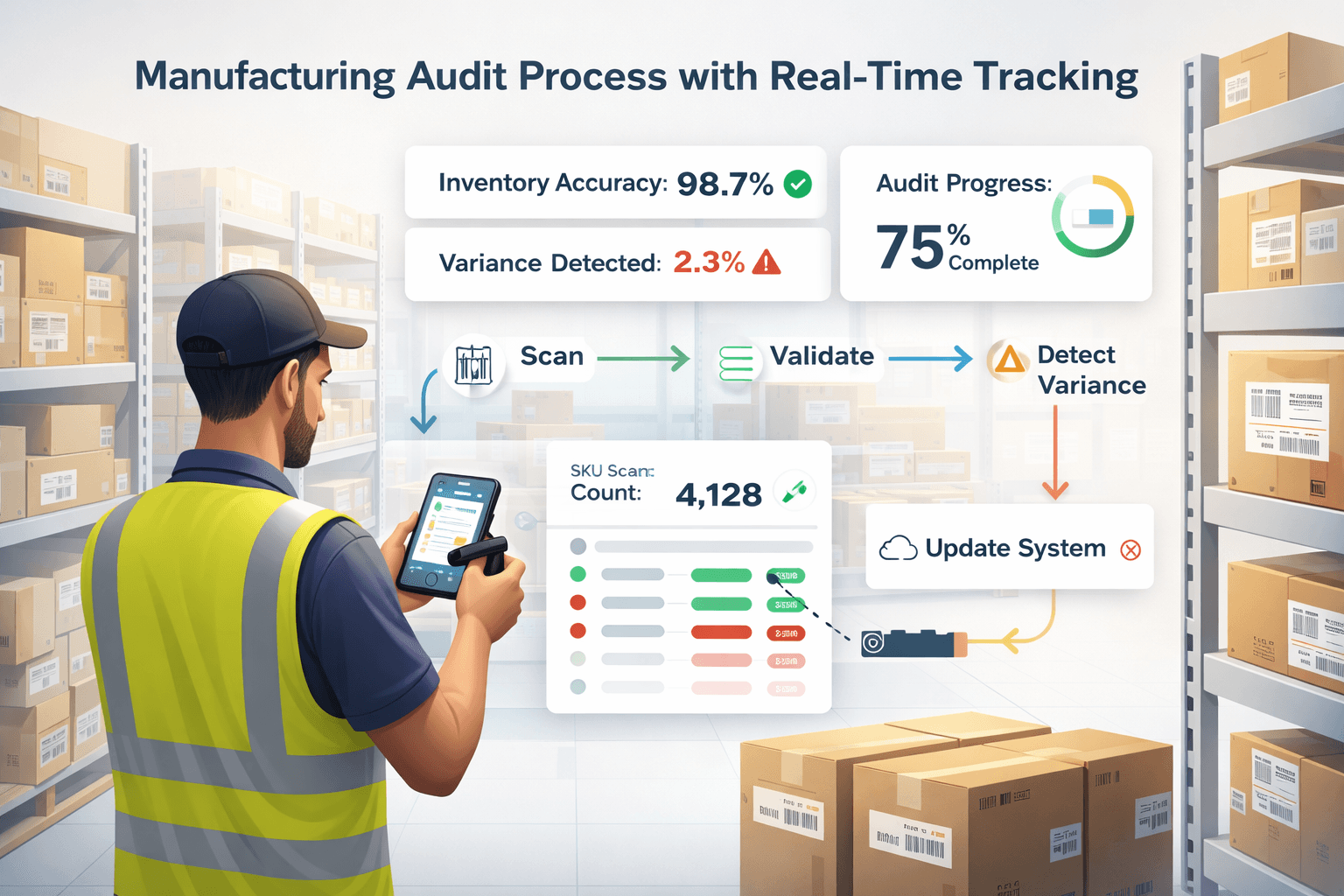
Step 1 — SKU Standardization Every item must have a unique, consistent identifier. Eliminate duplicate SKUs, merged part numbers, and informal naming conventions. This is the foundation of every accurate audit.
Step 2 — Barcode / QR Code Implementation Attach scannable identifiers to every item, bin, shelf, and pallet. This eliminates manual data entry at the point of movement — the single biggest source of error.
Step 3 — Real-Time Tracking System Setup Deploy inventory software that updates stock levels on every scan. Every receipt, transfer, pick, and adjustment should reflect instantly in the system.
Step 4 — Cycle Counting Schedule Replace the annual full count with rolling cycle counts. Count high-velocity SKUs weekly, mid-range monthly, and slow-movers quarterly. This distributes audit effort and catches discrepancies early.
Step 5 — Variance Detection After each count, automatically flag any item where physical count deviates from system records by more than your defined threshold (typically ±1–2%).
Step 6 — Root Cause Analysis Don't just correct the number — trace why the variance occurred. Was it a receiving error? An unrecorded transfer? A theft incident? Root cause analysis prevents recurrence.
Manufacturing Audit KPIs
| KPI | Formula | Benchmark |
|---|---|---|
| Inventory Accuracy % | (Correct SKU counts / Total SKU counts) × 100 | 98–99% |
| Shrinkage Rate | (Lost inventory value / Total inventory value) × 100 | < 1% |
| Stock Variance Value | System value − Physical count value | < 0.5% of total |
| Audit Completion Time | Time from count start to reconciliation | < 24 hours |
| Dead Stock % | (Units with 0 movement in 90 days / Total units) × 100 | < 5% |
Tracking these KPIs monthly gives you a continuous performance baseline and early warning of process breakdown.
See How Stockount Tracks Every KPI in Real Time
Most teams spend hours pulling audit data from spreadsheets. Stockount surfaces inventory accuracy, shrinkage rate, and variance value automatically, updated on every scan.
Book a Free Demo → Get a live 30-minute walkthrough of Stockount's manufacturing audit dashboard. No commitment required.
Manufacturing Audit Benchmarks (2026)
Stock Accuracy: World-class manufacturers maintain 98–99% inventory accuracy. Below 95% is considered operationally risky and is a common trigger for audit failures.
Acceptable Shrinkage: Industry standard targets shrinkage below 1% of total inventory value annually. High-theft or high-velocity environments should target below 0.5%.
Audit Frequency: Cycle counting is now the standard. Full annual counts should be replaced, or at minimum supplemented, by weekly and monthly cycle count schedules by SKU category.
How Real-Time Audit Software Improves Manufacturing Audits
Manual audits are slow, error-prone, and reactive. Modern inventory audit software flips that model entirely.
Live Inventory Tracking means every scan updates stock levels instantly. No waiting for batch uploads. No overnight sync delays.
Automated Reconciliation compares physical counts against system data the moment a count is submitted — flagging variances immediately rather than days later.
Mobile Audit Execution puts the audit in the hands of floor staff. Scan a barcode, confirm a count, flag a discrepancy — all from a mobile device, without leaving the warehouse floor.
Instant Variance Alerts notify the right people the moment a count falls outside threshold. Investigations start in hours, not weeks.
Stockount is built specifically for manufacturing environments — combining real-time inventory tracking, automated cycle count scheduling, and variance analytics in a single platform. Teams using Stockount have moved from 87% to 99% stock accuracy within 90 days of deployment.
Before vs. After a Manufacturing Audit System
| Before | After | |
|---|---|---|
| Tracking Method | Manual logs, spreadsheets | Real-time barcode scanning |
| Stock Accuracy | 85–90% | 98–99% |
| Audit Duration | 3–5 days (annual full count) | Rolling cycle counts, hours per session |
| Variance Detection | Month-end or year-end | Real-time alerts |
| Reconciliation | Manual, error-prone | Automated, instant |
| Root Cause Visibility | Minimal | Full audit trail |
Common Manufacturing Audit Mistakes
Skipping Cycle Counts Relying solely on annual counts means errors accumulate for 12 months before anyone catches them. Cycle counting is non-negotiable for high-accuracy environments.
No SKU Standardization Running an audit with inconsistent part numbers, duplicate entries, or informal labels guarantees inaccurate results — regardless of how thorough the count is.
Ignoring Audit Data Completing the count is only half the job. If variance data isn't analyzed and acted on, the same errors repeat in the next cycle.
Over-Reliance on Excel Spreadsheets don't scale, don't update in real time, and introduce formula errors. They're a liability in any operation handling more than a few hundred SKUs.
Frequently Asked Questions
What is a manufacturing audit?
A manufacturing audit is a systematic process to verify that physical inventory matches recorded system data in a production or warehouse facility. It identifies discrepancies, reduces shrinkage, and improves stock accuracy. Most manufacturers target 98–99% accuracy through regular cycle counts and real-time inventory tracking.
How often should manufacturing audits be done?
High-velocity SKUs should be counted weekly, mid-range items monthly, and slow-movers quarterly. A full annual physical count is still common for financial reporting but should be supplemented with continuous cycle counting to maintain year-round accuracy.
What is a good inventory accuracy rate in manufacturing?
World-class manufacturing operations target 98–99% inventory accuracy. Anything below 95% signals a systemic process problem and typically leads to production delays, emergency purchasing, and customer fulfilment failures. Most facilities start cycle counting once they drop below 97%.
How do you reduce stock discrepancies in manufacturing?
Reduce discrepancies by standardizing SKUs, implementing barcode or QR scanning at every stock movement point, scheduling regular cycle counts, and using real-time inventory software that flags variances automatically. Root cause analysis after each variance prevents the same errors from recurring.
Achieve 99% Stock Accuracy — Starting Today
Stock mismatches don't fix themselves. Every day without a structured manufacturing audit is another day of invisible losses, delayed production, and unreliable data.
The path to 99% accuracy is clear: real-time tracking, automated reconciliation, and cycle counts that catch problems before they compound.
Stockount gives your team real-time inventory visibility, automated cycle count scheduling, and instant variance alerts — built specifically for manufacturing floors.
Explore the Platform → See every feature, every workflow, and how Stockount fits your operation. No sales pressure. Just clarity.
Stockount — Built for manufacturing. Designed for accuracy.