Why Stock Counting Is Necessary: Real Cost of Inventory Drift
| By Stockount
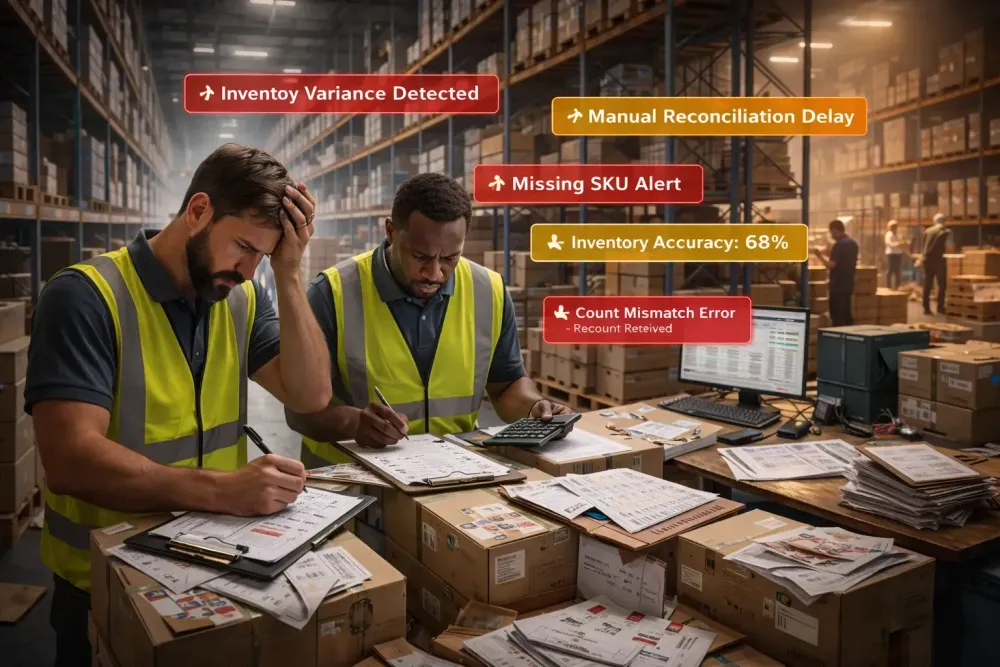
A warehouse manager walks the aisles on a Monday morning. The system says 480 units of a fast-moving SKU are in stock. The shelf holds 312. Nobody flagged a theft. Nobody filed a damage report. The product simply… drifted. By the time the variance is noticed, three customer orders have already been promised against inventory that doesn't exist.
This is the quiet operational tax most businesses pay every single day. It rarely shows up as a single dramatic loss. Instead, it accumulates, a few units here, a misplaced pallet there, a vendor short-ship that nobody reconciled, until the gap between system inventory and physical inventory becomes a structural problem.
That gap has a name: inventory drift. And it's the single biggest reason stock counting is non-negotiable for modern operations.
A landmark Harvard Business School study of retail inventory accuracy found that roughly 65% of inventory records did not match physical counts, with discrepancies widening as SKU complexity grew. In other words, two out of every three records in an "accurate" inventory system were wrong. Most operations leaders are running their forecasting, purchasing, and customer promises on data that is silently decaying.
This article breaks down exactly why Stock (inventory) counting matters, what happens financially and operationally when businesses stop counting, and the metrics every inventory controller should be watching.
What Is Stock Counting?
Stock counting also commonly referred to as inventory counting is the process of physically verifying inventory and reconciling it against the quantities recorded in your inventory management system. The two terms are used interchangeably across retail, warehousing, and supply chain operations
It generally takes three forms:
- Cycle counting — counting a small subset of SKUs on a rotating schedule (daily or weekly) so the entire inventory is verified over a defined period without halting operations.
- Inventory audits — comprehensive, often full warehouse counts conducted quarterly, semi-annually, or annually to validate financial reporting and compliance.
- Inventory reconciliation — the post-count process of investigating variances, identifying root causes (vendor errors, miscounts, shrinkage, system mistakes), and correcting records.
Each format serves a different purpose, but together they form the only mechanism that keeps inventory data honest.
Why Stock Counting Is Necessary
1. Inventory Accuracy
Accurate inventory is the foundation every downstream system depends on purchasing, replenishment, demand planning, e-commerce promises, and finance. When accuracy drops below 95%, every system built on top of it starts producing flawed outputs.
2. Revenue Protection
A stockout on a top-velocity SKU doesn't just lose one sale. It pushes customers toward competitors and erodes lifetime value. Counting prevents the "phantom inventory" problem where systems show stock that physically isn't there.
3. Forecasting Improvement
Forecasting models are only as accurate as the inventory history they learn from. Drifted data produces drifted predictions, which lead to over-ordering of slow movers and under-ordering of fast movers.
4. Shrinkage Reduction
The National Retail Federation reports that retail shrinkage averages around 1.44% of sales, driven by administrative errors, vendor mistakes, employee theft, and operational inaccuracies. Regular counting is the primary control that surfaces shrinkage before it compounds.
5. Warehouse Efficiency
Pickers waste hours hunting for stock that systems say exists. Counting tightens slot accuracy, reduces pick errors, and shortens fulfilment cycles.
6. Customer Satisfaction
B2B and B2C customers measure suppliers on order accuracy and on-time delivery. Both metrics collapse the moment inventory data becomes unreliable.
Start counting smarter, not harder. Businesses looking to reduce stock discrepancies and improve real-time inventory visibility can explore Stockount's free trial to simplify warehouse audits, mobile cycle counts, and reconciliation workflows, without disrupting daily operations.
What Happens If Inventory Is Not Counted?
The cost of skipping stock counts is rarely visible in week one. It's the compounding curve that destroys margins.
After 1 Week
Minor variances appear, a few mis-picks, a missed putaway, a vendor short-ship that wasn't logged. Picking accuracy drops by a fraction of a percent. On its own, harmless.
After 1 Month
The variances start clustering on high-velocity SKUs. Forecasting models begin ingesting slightly distorted sales data. Customer service starts fielding occasional "we promised stock we didn't have" calls.
After 6 Months
Accuracy gaps become structural. Shrinkage is now harder to trace because too much time has passed since the last reliable baseline. Dead stock starts accumulating in corners of the warehouse no one audits. Working capital begins quietly tying itself up in the wrong SKUs.
After 1 Year
Inventory data is now unreliable enough that purchasing decisions are essentially guesses dressed up as analytics. Financial reporting risk rises, auditors flag inventory valuation as a concern. The classic symptom of this stage is exactly what Nike experienced when North American inventory rose by 65%, forcing aggressive markdowns that compressed margins. Excess and imbalance, not theft, did the damage.
After 5 Years
Operational inefficiency is normalized. Teams build manual workarounds , spreadsheets, side counts, "trust the senior picker" heuristics,to compensate for unreliable system data. Scaling becomes painful because every new location inherits the same broken baseline. Revenue leakage at this stage is rarely recoverable through a single fix.
Real Business Consequences of Poor Inventory Visibility
Inventory drift doesn't stay in the warehouse. It radiates through the P&L.
- Overstocking — buyers over-order to compensate for unreliable data, inflating carrying costs.
- Dead stock — slow-moving SKUs accumulate, consuming shelf space and capital.
- Shrinkage — undetected losses compound silently between audits.
- Fulfilment delays — pickers waste time searching for phantom inventory.
- Margin erosion — markdowns and emergency air-freight replenishments destroy profitability.
- Working capital blockage — cash sits frozen in the wrong inventory, starving growth initiatives.
Independent retail audit research has consistently shown that disciplined inventory audits improve stock availability and lift sales performance, simply because the right products are actually on the shelf when customers want them.
Important Inventory Metrics Businesses Should Track
You can't fix what you don't measure. Six metrics belong on every operations dashboard:
- Inventory Accuracy % — units physically present vs. units in the system. World-class operations target 98%+.
- Shrinkage Rate — value of lost inventory as a percentage of sales. Benchmark against the NRF average of ~1.44%.
- Inventory Turnover — how many times inventory cycles through in a period. Low turnover signals overstocking.
- Audit Variance % — the gap surfaced during each count. Trending upward = drift is accelerating.
- Stockout Rate — percentage of SKUs unavailable when demanded. Directly tied to lost revenue.
- Dead Stock % — share of SKUs with no movement over a defined window. Reveals trapped working capital.
How Modern Inventory Counting Solves These Problems
Manual, paper-based counts are themselves a source of error. Modern inventory operations replace them with:
- Barcode and QR scanning for first-time-right capture
- Mobile inventory audits that let teams count from the aisle, not the office
- Real-time inventory tracking across warehouses, stores, and dark stores
- Automated reconciliation that flags variances the moment they appear
- Multi-location visibility so head office sees what every node holds in real time
- Inventory variance alerts that trigger investigation before drift compounds
Real-time inventory visibility through tools like Stockount helps reduce inventory drift before it becomes a quarterly write-off.
How Stockount Helps Businesses Improve Inventory Accuracy
Stockount is built for the operational reality of high-SKU, multi-location businesses, retail chains, hypermarkets, distributors, manufacturers, and 3PLs.
Warehouse and store teams use mobile stock counting on any device to run cycle counts without halting operations. Variances are surfaced through automated discrepancy detection, not weekly spreadsheet exports. Inventory controllers get audit-ready reporting that finance teams can use during quarterly close. And operations leaders gain multi-location inventory visibility so a stockout at one location can be solved by a transfer from another, not an emergency PO.
The underlying logic is simple: catch drift early, count continuously, and let the system do the reconciliation math. Businesses using platforms like Stockount typically see manual reconciliation hours drop sharply within the first counting cycle.
Book a Demo: See Inventory Accuracy in Action
If your team is wrestling with mismatched stock records, delayed audits, or growing variance between system and shelf, the operational cost is already compounding, even if it hasn't surfaced in the P&L yet.
Businesses struggling with inventory discrepancies, stock inaccuracies, or audit delays can book a demo with Stockount to see how real-time inventory tracking, mobile stock counting, and automated reconciliation improve operational visibility across every warehouse and store.
Frequently Asked Questions
Why is inventory counting important?
Inventory counting keeps physical stock and system records aligned. Without it, forecasting, purchasing, customer promises, and financial reporting are built on data that silently decays — Harvard research found about 65% of inventory records were inaccurate at any given time.
How often should businesses conduct an inventory audit?
Most operations run daily or weekly cycle counts on high-velocity SKUs and a full inventory audit quarterly or semi-annually. High-shrinkage categories (electronics, cosmetics, apparel) usually justify more frequent counts.
What causes inventory shrinkage?
The four leading causes are administrative errors, vendor mistakes, employee theft, and operational inaccuracies. The NRF reports average retail shrinkage at around 1.44% of sales.
What is a good inventory accuracy percentage?
98% or higher is the benchmark for world-class operations. Below 95%, downstream systems, forecasting, replenishment, fulfilmentbegin producing unreliable outputs.
What is cycle counting and how is it different from a full audit?
Cycle counting verifies a small subset of SKUs on a rotating schedule without stopping operations. A full audit counts the entire inventory at once, usually for financial reporting. Cycle counting catches drift earlier and is less disruptive.
How does warehouse stock counting improve profitability?
It reduces stockouts, prevents overstocking, surfaces shrinkage early, frees up working capital trapped in dead stock, and improves order accuracy,each of which directly protects margin.