Cycle Counting Software: The Complete Buyer's Guide for Warehouses, Retail & Manufacturing
| By Stockount
Introduction
It's 11 PM and your warehouse team is still counting. Spreadsheets are open on three laptops, someone's reading SKU numbers off a clipboard, and by the time the numbers get reconciled tomorrow, half of them won't match what's in your ERP anyway.
This is what manual cycle counting looks like in most operations,-- not because teams are careless, but because pen-and-paper and Excel were never built for the job. A single miskeyed digit on a spreadsheet turns into a stock-out three weeks later. A missed bin location becomes a customer order that can't be fulfilled. A quarterly "full count" that takes four days to complete means you're making purchasing and sales decisions on data that's already stale by the time it's finalized.
The cost of this isn't abstract. Inventory discrepancies quietly erode margins through emergency reordering, write-offs, and lost sales from phantom stock. And the worse the discrepancy gets, the longer the eventual "fire-fighting" audit takes, a vicious cycle that consumes more staff hours every quarter, not fewer.
This isn't a small-business problem you can ignore. Industry shrinkage benchmarks put median inventory loss at roughly 1.4-1.6% of sales for retailers, and administrative errors, including cycle count discrepancies, data entry mistakes, and mispriced or misplaced goods, account for around a fifth of that loss on their own (National Retail Federation research, via industry shrink studies). Run that against a mid-sized operation doing even a few million in annual turnover, and "small" errors translate into real six or seven-figure leakage every year.
This is exactly the gap that purpose-built cycle counting software closes. Instead of a chaotic annual shutdown or an error-prone Excel exercise, cycle counting software lets you count small, manageable sections of inventory continuously, on a schedule, with barcode scanning, and without stopping operations. Platforms like Stockount take this further with mobile-first, offline-capable counting built specifically for retailers, warehouses, distributors, and manufacturers who need audit accuracy without an enterprise ERP price tag or implementation timeline.
In this guide, we'll break down what cycle counting software actually is, why manual methods fail at scale, the features that separate good tools from great ones, and how to evaluate options, including a transparent, no-spin comparison table, so you can choose the right fit for your business.
What Is Cycle Counting Software?
Cycle counting software is a digital system that lets businesses count a subset of their inventory on a rolling, scheduled basis, rather than shutting down operations once or twice a year for a full physical count. Each cycle count typically covers a specific zone, category, or set of SKUs, with the results automatically reconciled against system records.
Definition, in plain terms
Instead of counting everything at once, you count a little, often. A warehouse with 10,000 SKUs might count 200 high-priority items every week, ensuring the entire inventory gets audited multiple times a year, with discrepancies caught in days, not months.
Core benefits
- Continuous accuracy instead of a once-a-year snapshot
- No operational shutdown — counting happens alongside normal picking, packing, and receiving
- Faster discrepancy detection, so root causes (theft, damage, mis-shelving, data entry errors) get caught while evidence is still fresh
- Lower audit labor cost per count, since each cycle is small and scheduled during normal hours
Business examples
- A distributor scans and verifies its top 20% fastest-moving SKUs weekly, since these carry the highest financial and stock-out risk.
- A retail chain runs a rolling count across store locations so head office always has a current, trustworthy stock picture — without ever closing a store for inventory day.
- A manufacturer cycle-counts raw materials before each production run to prevent line stoppages caused by phantom stock.
Who needs it
Any business carrying physical inventory that currently relies on manual counts, spreadsheets, or infrequent full audits, particularly warehouse managers, operations and inventory managers, retail and store owners, supply chain leads, and manufacturing or distribution companies managing multiple locations.
→ You can run a 10-minute quick audit with Stockount before you commit to any tool — it takes less time than reading the rest of this guide.
Why Businesses Need Cycle Counting Software
Manual counting doesn't fail because people are bad at their jobs — it fails because the method has structural limits that get worse as a business scales.
- Inventory discrepancies compound. A 2% error rate sounds small until it's applied across 15,000 SKUs and multiple locations — that's hundreds of mismatched records feeding into purchasing, finance, and fulfillment decisions.
- Stock shrinkage goes undetected for months. Without frequent counts, shrinkage from damage, misplacement, or theft isn't caught until a full audit — by which point the cause is nearly impossible to trace.
- Manual data entry introduces errors at every handoff. Clipboard → spreadsheet → ERP means at least two opportunities for a transcription mistake on every single line item.
- Full physical audits take too long. A multi-day shutdown to count everything at once disrupts fulfillment, frustrates staff, and still only gives you a picture that's accurate for a single moment in time.
- Excel doesn't scale. Formulas break, version conflicts multiply across shared files, and there's no audit trail of who counted what, when, or whether it was verified.
- Warehouse inefficiencies stack up. Without a directed, systematic counting process, teams re-check the same bins repeatedly while others go untouched for a year or more.
- Compliance and audit-readiness suffer. Industries with regulatory or investor reporting requirements need a defensible, timestamped record of inventory accuracy — something a spreadsheet simply cannot provide.
By the numbers: U.S. retail shrinkage alone has been estimated at $90-112 billion annually in recent industry reports, with administrative and process errors — the exact category cycle counting is designed to catch — making up a meaningful share of that figure. The pattern holds globally: the less frequently you count, the more expensive your blind spots get.
→ See where your own inventory stands run a free Stockount audit check before your next stock-take turns into a fire drill.
Key Features to Look For in Cycle Counting Software
Not all "inventory apps" are built for audits. When evaluating cycle counting software, prioritize:
- Barcode scanning — for fast, error-resistant counting using any smartphone or dedicated scanner
- Offline counting — critical for warehouses and rural or Tier-2/3 retail locations with unreliable connectivity
- Mobile app access — so counts can happen on the floor, not at a desk after the fact
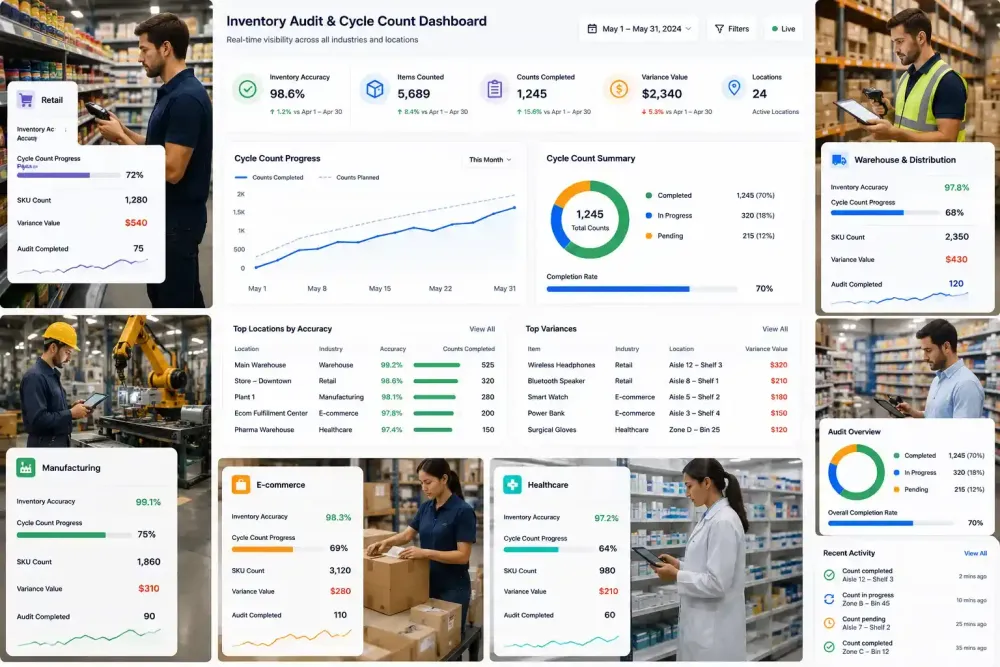
- Real-time dashboard — live visibility into count progress, completion rates, and flagged variances
- Inventory reconciliation — automatic matching of counted quantities against system records
- Variance reports — clear breakdowns of what didn't match, by how much, and where
- Audit history — a permanent, timestamped log of every count for accountability and compliance
- Role-based access — so counters, supervisors, and admins each see only what they need to
- Cloud sync — counts update centrally the moment connectivity is restored
- Multi-location support — one dashboard across every warehouse, store, or distribution center
- ERP integration — for businesses that need counted data to flow directly into existing systems
Mobile Cycle Counting Software: Why It's Become the Default Choice
Desk-bound, browser-only inventory tools force a broken workflow: someone counts on paper, then walks back to a terminal to enter it. Mobile cycle counting software removes that middle step entirely. Counters scan and record directly on the warehouse or shop floor using a phone or handheld device, and the system reconciles the count the moment it's entered — no re-keying, no lag between "counted" and "recorded." For teams managing multiple aisles, zones, or store locations, this alone is often the single biggest time saver in the entire audit process.
Cloud Cycle Counting Software: Real-Time Visibility Across Every Location
Cloud-based cycle counting software means every count — from every warehouse, store, or distribution point — syncs to one central dashboard the moment it's completed. Regional managers, ops leads, and finance don't wait for a weekly roll-up email; they see live progress and variance data as it happens. For multi-location businesses in particular, this replaces a patchwork of spreadsheets sent over email with a single source of truth everyone works from.
Expert Tip: When evaluating cloud-based tools, ask specifically how the platform handles connectivity drops, not every "cloud" tool is built to keep working when the internet isn't. This is where offline-capable platforms like Stockount separate from browser-only competitors.
Benefits of Using Stockount
Stockount is built around one idea: inventory audits shouldn't require an IT project or a warehouse shutdown to get right. Teams using a mobile-first cycle counting workflow like Stockount's typically see:
- Faster inventory audits — counts that took days on paper are compressed into hours with barcode scanning and directed workflows
- Improved inventory accuracy — frequent, structured counts catch discrepancies before they snowball
- Reduced stock shrinkage — regular verification makes shrinkage visible early, while the cause is still traceable
- Lower labor costs — smaller, scheduled counts replace expensive, disruptive full-scale audits
- Real-time visibility — managers see count progress and variances the moment they happen, not after end-of-day data entry
- Better decision-making — purchasing, sales, and finance teams work from inventory numbers they can actually trust
- Improved warehouse productivity — counting runs alongside picking and receiving instead of stopping them
→ Start a free Stockount trial and run your first cycle count today, no ERP migration, no setup week.
Manual Counting vs Excel vs Traditional ERP vs Stockount
| Comparison Factor | Manual Counting | Excel | Traditional ERP | Stockount |
|---|---|---|---|---|
| Accuracy | Low — human error at every step | Medium — formula/version errors common | High, but slow to update | High — scan-verified, real-time |
| Speed | Very slow | Slow, manual entry | Moderate — heavy setup | Fast — mobile scan & sync |
| Cost | Low upfront, high hidden labor cost | Low, but scales poorly | High (license + implementation) | Affordable, scales with usage |
| Automation | None | Minimal | Partial, complex to configure | Built-in audit workflows |
| Barcode Support | No | No (manual lookup only) | Often requires add-on modules | Native, mobile-based |
| Offline Capability | N/A | No | Rare | Yes — count without connectivity |
| Reporting | Manual compilation | Manual, error-prone | Strong but rigid | Real-time variance dashboards |
| Scalability | Poor | Poor beyond small inventories | Good, but expensive to expand | Built to scale across multi-location operations |
| Implementation Time | None (but ongoing pain) | None | Weeks to months | Days |
→ Book a live demo to see this comparison in action on your own inventory data.
Industries That Benefit from Cycle Counting Software
- Retail — multi-store chains needing consistent stock accuracy without closing shop for inventory day
- Manufacturing — raw material and WIP counts that prevent production-line stoppages
- Wholesale & Distribution — high-SKU-volume operations where fast-moving stock needs frequent verification
- Healthcare — regulatory-grade traceability for medical and pharmaceutical inventory
- Automotive — parts and component tracking across dealerships and service centers
- Food & Beverage — perishable stock requiring frequent, accurate turnover checks
- Logistics — cross-dock and 3PL environments where inventory visibility directly affects SLAs
- Warehousing — multi-zone facilities that need directed, systematic count coverage year-round
How Stockount Works
- Create Audit — Define the scope: a warehouse zone, product category, or full-location count, scheduled on your terms.
- Assign Team — Allocate counters and supervisors with role-based access, so responsibility is clear from the start.
- Scan Barcode — Counters scan items on the floor using the mobile app, online or offline.
- Verify Inventory — Counted quantities are automatically checked against system records, flagging mismatches instantly.
- Generate Reports — Variance reports, audit trails, and dashboards are ready the moment counting finishes — no manual compilation.
Real Business Scenario: From Chaotic Quarterly Counts to Continuous Accuracy
Consider a mid-sized distribution business running a single warehouse with around 8,000 active SKUs across multiple product categories. Before adopting a structured cycle counting process, their inventory audit was a quarterly event: the warehouse shut down for two full days, staff counted using printed sheets, and a finance team member spent the following week manually reconciling the paper counts against the ERP.
By the time discrepancies surfaced, there was no way to tell whether a shortage was from a shipping error three weeks earlier, a mis-shelved pallet, or a data entry mistake — the trail had gone cold. Emergency reordering to cover unexpected shortfalls was routine, and finance regularly had to explain inventory valuation gaps to leadership.
After moving to a mobile, barcode-based cycle counting process:
- High-velocity items were counted weekly instead of quarterly
- Barcode scanning eliminated manual data entry errors at the point of counting
- Variance reports flagged mismatches within hours, while causes were still traceable
- The warehouse never had to shut down — counts ran in parallel with picking and receiving Within a few months, audit time per cycle dropped by roughly 70%, since small scheduled counts replaced a disruptive full shutdown. Inventory accuracy improved measurably as root causes of shrinkage were caught early rather than discovered months later, and finance began working from stock data they could actually rely on for purchasing and reporting decisions.
This isn't a hypothetical pattern — it mirrors what Stockount customers report directly. Velavan Motorcycles (VMC Royal Enfield, Chennai) moved multi-location parts and accessory audits off paper registers onto scheduled mobile counts, cutting the coordination overhead of syncing counts across showroom and service floors. Lumino Industry Pvt. Ltd., a wires-and-cables manufacturer, applied the same approach to raw material and finished-goods stock, where miscounts previously risked halting production runs. Full documented details are available on the Stockount case study page.
A quick industry reality check: administrative errors — cycle count discrepancies, mispriced items, data entry mistakes — account for roughly one-fifth of all retail inventory shrinkage industry-wide, according to recent NRF-based shrink research. That's the exact slice of loss that structured, barcode-verified cycle counting is built to eliminate — no security cameras or loss-prevention staffing required, just an accurate count process.
This is the pattern purpose-built cycle counting software makes possible — not a one-time fix, but a structural change in how accurate a business's inventory data stays, week over week.
Why Choose Stockount?
- Mobile-first — built for counting on the warehouse floor or shop floor, not at a desk
- Offline counting — no dependency on constant connectivity, ideal for warehouses and Tier-2/3 retail locations
- Barcode-enabled — fast, error-resistant scanning using any smartphone
- Cloud-based — real-time sync and dashboards accessible from anywhere
- Easy implementation — live in days, not months, with no ERP migration required
- Affordable pricing — built for SMBs and mid-market businesses, not just enterprise budgets
- Fast onboarding & responsive support — teams are counting accurately within their first week → Compare Stockount plans and pricing — find the tier that fits your warehouse size.
Frequently Asked Questions
1. What is cycle counting software? It's a digital tool that lets businesses count inventory in small, scheduled batches, using barcode scanning and automated reconciliation, instead of relying on infrequent full physical counts.
2. How is cycle counting different from a physical inventory count? A physical count covers all inventory at once, usually requiring a shutdown. Cycle counting covers smaller sections on a rolling schedule, so the full inventory gets audited over time without stopping operations.
3. How often should cycle counts be performed? It depends on item value and turnover — high-priority (fast-moving or high-value) items are often counted weekly or monthly, while low-priority items may only need quarterly or annual counts.
4. Can cycle counting software work without an ERP system? Yes. Tools like Stockount are built to work standalone, with optional ERP integration for businesses that want counted data to flow into existing systems.
5. Does cycle counting software work offline? The best tools do. Stockount supports offline counting so warehouse staff can keep working through connectivity gaps, with data syncing automatically once back online.
6. What's the ROI of switching from manual to software-based cycle counting? Businesses typically see reduced audit labor hours, faster detection of shrinkage and errors, and fewer stock-outs or emergency reorders caused by inaccurate data — savings that generally outweigh subscription costs within the first few cycles.
7. Is cycle counting software suitable for small retail businesses? Yes — mobile-first tools scale down as easily as they scale up, making them practical for single-store retailers as well as multi-location chains.
8. What industries use cycle counting software most? Retail, manufacturing, wholesale and distribution, logistics, warehousing, healthcare, automotive, and food & beverage are the most common adopters.
9. How accurate is barcode-based cycle counting compared to manual counting? Barcode scanning removes manual transcription errors almost entirely, typically pushing count accuracy well above what's achievable with clipboard-and-spreadsheet methods.
10. Can multiple team members count at the same time? Yes — role-based access lets multiple counters work simultaneously across different zones, with a supervisor overseeing and approving results centrally.
11. What happens when a count doesn't match system records? The software flags it as a variance, showing the expected versus counted quantity so the team can investigate the cause — before it's finalized in the system.
12. Does cycle counting software support multi-location businesses? Yes — platforms like Stockount let you manage counts across multiple warehouses or stores from a single, centralized dashboard.
13. How long does it take to implement cycle counting software? Mobile-first tools without ERP dependencies can typically be live within days, compared to weeks or months for traditional ERP-based counting modules.
14. What's the difference between inventory audit software and cycle counting software? The terms are often used interchangeably. In practice, inventory audit software may cover broader compliance and reconciliation workflows, while cycle counting specifically refers to the scheduled, rolling counting method.
15. Can I try cycle counting software before committing? Yes, Stockount offers a free trial and live demo so teams can test the workflow on their own inventory before subscribing.
Conclusion
Manual cycle counting isn't just slow, it's a structural risk to inventory accuracy, margins, and decision-making. Excel and clipboard-based audits break down at scale, and traditional ERP counting modules often demand a level of setup and cost that many growing businesses can't justify.
Purpose-built cycle counting software closes that gap, replacing disruptive, error-prone full counts with continuous, barcode-verified accuracy that keeps your team, your finance data, and your customers' orders in sync.
Stockount was built for exactly this: mobile-first, offline-capable, affordable inventory auditing for retailers, warehouses, distributors, and manufacturers who need real accuracy without an enterprise-sized budget or timeline.
Ready to stop counting on hope? Book your free Stockount demo or start your free trial today — your first accurate audit could be running by this time next week.