Exclusive Offer: Sign up today and unlock 15 days of full feature access— 100% free!

How to Do a Cycle Count in a Warehouse: Step-by-Step Process for Operations Teams

| By Stockount

Warehouse staff conducting cycle counts in a modern distribution center using handheld barcode scanners, tablets, and real-time inventory management dashboards across organized storage racks and pallets.

Introduction

Quick Answer: To do a cycle count in a warehouse, freeze movement in the count zone, pull a timestamped ERP snapshot, assign counters to defined zones, have them count blind (without seeing system quantities), flag variances at the point of count, run an independent recount on any flagged item, investigate open transactions before adjusting, and log every adjustment with a reason code and audit trail. A disciplined cycle count process is what separates warehouses running at 97%+ inventory accuracy from those stuck at the industry average of 83%.

A cycle count is a recurring inventory verification method where a small subset of SKUs is counted on a rotating schedule while the warehouse continues to operate, without the shutdown of an annual physical inventory. Cycle counting inventory is the default approach used by high-performing distribution centers, retail chains, and 3PLs to keep ERP records aligned with physical stock. For a deeper background on the method itself, see our guide to what cycle counting is and its types. This article is the operational follow-up: how warehouse teams actually execute it.

It's 11:47 PM on a Sunday. The month-end inventory cutoff was supposed to close two hours ago. Your team is on its third recount of the same three bays because the ERP shows 1,240 units of a fast-moving SKU and the floor keeps coming back with 1,191. The audit committee meets Tuesday. The shipment that depends on this stock leaves Wednesday morning. And somewhere between receiving last week and tonight, 49 units evaporated, or never existed at all.

If you've worked in warehouse operations for any length of time, you've lived a version of this scene. A cycle count in theory is elegant: a rotating sample, a clean variance report, a quiet correction. In practice, cycle counting inventory is messy, time-pressured, and often run with people who are tired, scanners that misread, and bins that have moved since the last count.

This guide is for warehouse managers, inventory controllers, retail operations leaders, and supply chain teams who already understand the basics and need a sharper operational playbook, one that addresses what actually goes wrong during execution, how to design workflows that hold up under pressure, and how to close the loop between physical counts and ERP records without spiraling into recount marathons.

Cycle Count Process at a Glance

Before going deep, here is the warehouse cycle count process in compressed form:

  1. Select the SKUs or zones to count using a documented trigger
  2. Freeze stock movement in the count zone
  3. Snapshot the ERP/WMS quantity at the freeze moment
  4. Assign counters to zones with named accountability
  5. Count blind — counters don't see system quantity
  6. Flag variances at the point of count
  7. Recount any flagged variance with a second, independent counter
  8. Investigate open transactions, overflow bins, and UoM mismatches before adjusting
  9. Adjust the ERP record with a documented reason code
  10. Log the full audit trail, counter, recount, approver, timestamps

The rest of this guide is what actually makes each of these steps work on a live warehouse floor.

Why Cycle Counts Fail in Real Warehouse Operations

Most cycle count programs don't fail because the method is wrong. They fail because the execution conditions are wrong. Industry data backs this up: research from CAPS Research found that the average inventory accuracy rate across surveyed organizations in 2024 was roughly 83%, with only about 69% of companies actually tracking the KPI. That's well below the 95–99% number most operations leaders assume their warehouses are running.

In our experience working with warehouse audits, five operational failures account for the bulk of bad cycle counts.

Rushed counts squeezed into shrinking windows. When the operations day runs over, the cycle count window shrinks first. Counters skip verification steps, scan estimates instead of unit counts, and submit results that look complete but are operationally incomplete.

Poor zone assignment. Two counters walking into the same aisle from opposite ends, or one counter assigned a zone that overlaps with active receiving, guarantees variance noise that has nothing to do with real stock loss.

Spreadsheets as the system of record. Paper tally sheets and offline Excel workbooks introduce predictable failures: transcription errors, missed bins, version mismatches between two team leads. By the time the spreadsheet is consolidated, the warehouse has moved on.

Shared accountability that nobody actually owns. When everyone is "responsible" for the count, no one is responsible for the variance. Without a named counter, supervisor, and reconciler tied to each count batch, post-count investigation stalls or never starts.

No audit trail. When a discrepancy shows up next month and someone asks "who counted bay C-14 on the 18th?", a good cycle count program answers in seconds. A weak one can't answer at all.

These aren't theoretical problems. They are the operational defaults that emerge whenever a cycle count program isn't designed to push back against warehouse pressure.

Preparing for a Successful Cycle Count: The 24-Hour Pre-Count Window

The quality of any cycle count is largely decided before counting begins. A well-prepared count finishes in 60 minutes; a poorly-prepared one turns into a four-hour recount marathon that ends with adjustments nobody trusts.

A clean pre-count window looks like this:

  • Zone freeze rules confirmed. Picks, put-aways, and receipts in the count zone are paused for the count window. The freeze is communicated to floor supervisors in writing, not just verbally.
  • Bin and rack labels verified. A counter wasting six minutes deciphering a damaged label is six minutes lost across every bin in the zone. Walk the zone the day before and replace any unreadable labels.
  • Mobile scanners charged and tested. Dead batteries at minute fifteen are an avoidable, recurring problem. Test scans against a known SKU before the team enters the floor.
  • Counters briefed. A short pre-count huddle — what's being counted, where, in what unit of measure, what constitutes a flag for recount — saves an hour of rework later.
  • Counter–stock handler separation. Counters should not be the same people who handle stock in that zone. Familiarity creates assumptions, and assumptions skip verification.
  • System snapshot timestamped. Pull the ERP or WMS quantity at the exact moment the freeze begins. Counting against a quantity from earlier in the day will produce a variance that isn't actually a variance.

A simple pre-count checklist, signed off by the shift supervisor, eliminates the most common preventable failures:

Pre-Count Checklist Item Owner Status
Freeze zone communicated to floor Shift supervisor
Bin labels verified readable Floor lead
Scanners tested and fully charged Equipment owner
System snapshot pulled at freeze moment Inventory controller
Counter assignments posted by zone Audit lead
Pre-count briefing complete Audit lead
Recount threshold defined for shift Audit lead

The Step-by-Step Warehouse Cycle Count Process

Below is the operational workflow we'd recommend for any team running a cycle count in a warehouse, not the textbook version, but the version that survives interruptions, edge cases, and tired counters at hour three.

Step 1: Select SKUs or zones using a defensible trigger

Don't choose what to count by feel. Choose based on a documented trigger: scheduled rotation, last-count age, recent variance history, post-receiving verification, or a high-velocity flag. When the variance report goes to finance, "we counted it because it was on the schedule" is a defensible answer. "We counted it because someone thought it was off" is not.

Step 2: Lock the system quantity at the freeze moment

Timestamp matters. Pull the ERP or WMS quantity at the precise moment movement is frozen in the count zone. Every variance investigation later will depend on this snapshot being clean.

Step 3: Brief and assign counters

Each counter gets a named zone, a defined SKU list (or "everything in the zone"), and a scanner. Pairing one experienced counter with one newer counter reduces error and accelerates training. Avoid letting any counter work alone in a high-value zone.

Step 4: Count blind, on the floor

The counter records the physical count without seeing the system quantity. This isn't a trust issue, it's a bias issue. A counter who sees "system says 240" and counts 237 will look again before recording. A blind counter records 237 and moves on, and the variance flag triggers the verification process that's supposed to happen. Blind counting is the single highest-leverage discipline in any cycle count process.

Step 5: Flag variances at the point of count

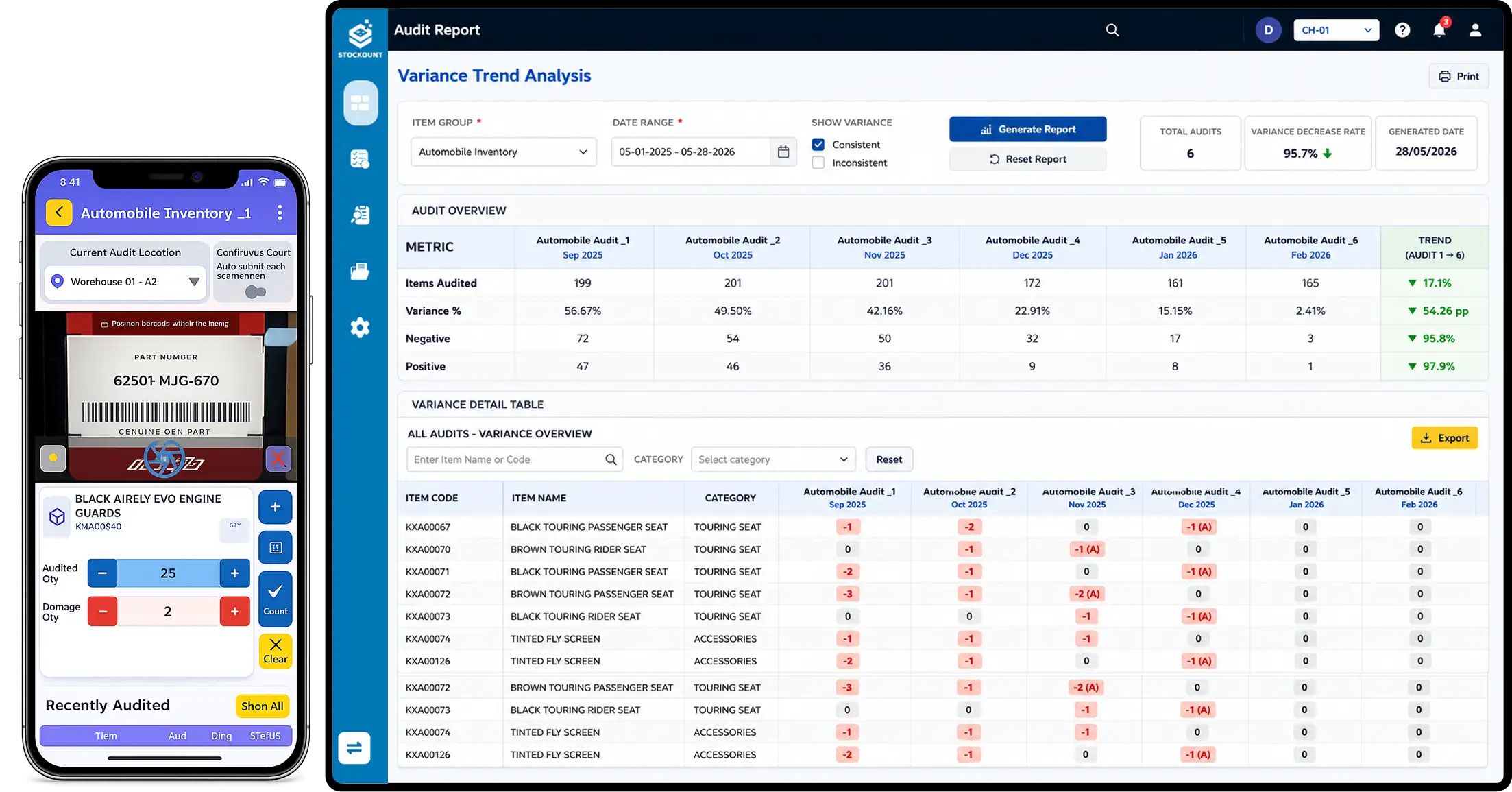
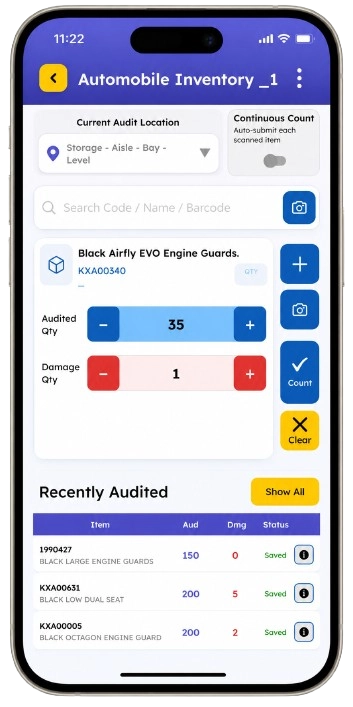
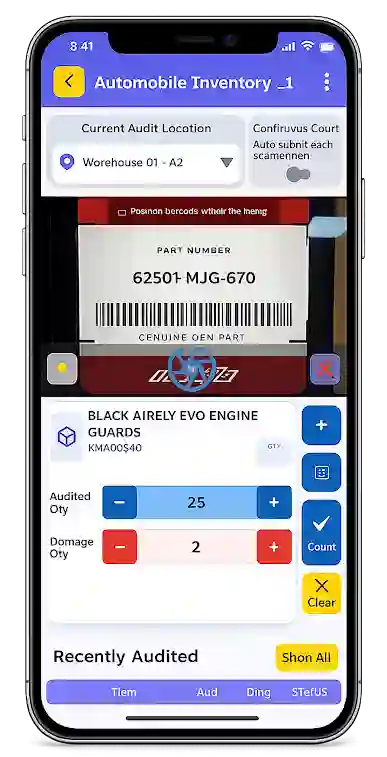
Variances are flagged in the field, not at the end of the shift. Mobile audit tools surface the discrepancy the moment the count is submitted, which means the counter is still in front of the bin when the recount conversation happens. That's the single most efficient moment to verify.

Step 6: Run the first-pass recount

Any variance above the agreed threshold, typically anything beyond 2–3% of the on-hand quantity, or any variance on an A-class SKU, triggers an immediate, independent recount by a second counter. Not the original counter. Not the supervisor who briefed them. A different pair of eyes on the same bin.

Step 7: Escalate suspicious variances

If the recount confirms the original count, the variance escalates. A supervisor reviews open transactions, recent receipts, partial picks, and overflow locations before any adjustment is approved. A meaningful share of variances at this stage turn out to be timing or documentation issues, not actual stock loss, but only if someone looks.

Step 8: Investigate before adjusting

Before any ERP record is changed, the investigator answers four questions:

  1. Was a receipt pending at the freeze moment?
  2. Was a pick in progress that wasn't captured?
  3. Are there overflow or secondary bin locations holding the same SKU?
  4. Is the unit of measure correct each packs vs. cases vs. inner packs?

An adjustment made without this check creates a clean-looking record and a hidden problem that will resurface in two count cycles.

Step 9: Reconcile with documented reason codes

When the adjustment is approved, it is recorded with a reason code: receiving error, picking error, damage not logged, vendor short ship, system unit-of-measure mismatch, suspected shrinkage, transfer not processed, or other. Reason codes are what turn cycle counting from a band-aid into a feedback loop. Without them, you fix the number every month and never fix the process.

Step 10: Log the full audit trail

Counter ID, recount ID, supervisor approver, timestamps, before/after quantity, reason code, and supporting notes. This is what makes the count defensible to an external auditor — and what makes future investigations possible when a pattern emerges three counts later.

Skip the spreadsheets and recount marathons. Stockount runs the cycle count workflow above with mobile blind counting, real-time variance alerts, and automated audit trails — in one platform. Start a free 15-day trial → (no credit card)

How High-Performing Teams Reduce Stock Variance

The teams that consistently land near 97%+ inventory accuracy share a few operational habits that aren't about counting harder, they're about counting smarter.

Continuous counting culture. Cycle counts happen on a daily or near-daily cadence, not in monthly catch-up sessions. The volume per count is smaller, the disruption is smaller, and the error window is narrower.

Real-time variance alerts. Variances don't wait for end-of-shift reconciliation. The moment a count is submitted and a gap is detected, the supervisor sees it. The recount happens within the same hour.

Variance thresholds tied to action. Different thresholds trigger different responses. A common framework:

Variance Range Required Action
0–2% on B/C items Auto-approve adjustment with reason code
2–5% on any item Mandatory recount before adjustment
5%+ on any item, OR any variance on A items Recount + supervisor investigation
10%+ or high-value variance Recount + supervisor + finance sign-off

Root-cause tracking. Every adjustment has a reason code, and reason codes are reviewed monthly. If receiving errors account for 40% of variance, the fix isn't in counting, it's in the receiving SOP.

Mobile counting tools. Scanner-driven counts eliminate the entire category of transcription errors and cut count time roughly in half versus paper-based methods.

Cycle Counting Inventory During Live Warehouse Operations

The hardest cycle counts are the ones that have to happen while the warehouse is still running. After-hours counts are cleaner, but they cost overtime and burn out counters. Daytime cycle counting inventory during active operations is cheaper but operationally fraught. A few realities to plan for:

Counting fatigue is real and measurable. After about three hours of continuous counting, error rates climb noticeably. High-performing programs limit any single counter to two-hour counting blocks with a clear rotation off the floor.

Damaged barcode labels create silent variance. A label that scans intermittently leads to either skipped bins or duplicate scans, depending on how the counter compensates. Both inflate variance reports for reasons that have nothing to do with stock loss.

Receiving in progress will create mismatches. A pallet sitting in the receiving dock that has been physically delivered but not yet system-receipted is the single most common source of false negative variance, the system shows less than the floor because the receipt hasn't been posted. Either freeze receiving in the count zone or explicitly exclude in-transit stock from the count.

Picks interrupting the count zone. Even with a zone freeze, an urgent customer order can override the freeze. When that happens, document the override at the moment it occurs and reconcile the variance against the documented pick after the count.

Peak-season counts. During promotional runs, month-end shipping, or holiday surge, the cycle count window often gets cut or skipped. This is exactly when discipline matters most, because peak periods generate the most receiving and picking errors. Reducing the count load counting fewer SKUs but counting them properly, is always better than skipping the count entirely.

The Zebra 2024 Warehousing Vision Study, based on responses from more than 1,700 warehouse associates and decision-makers across manufacturing, retail, transportation, and logistics, found that a majority of warehouse operators plan to accelerate modernization. More than three-quarters of decision-makers acknowledge they need better inventory management tools to achieve better accuracy and determine availability. Recognition is the easy part. The harder part is rebuilding the count workflow so the tools actually get used during the operational hours when they're needed most.

Common Operational Mistakes That Inflate Variance

The errors that hurt cycle count accuracy aren't usually dramatic. They're small, repeated mistakes that compound across hundreds of counts:

  • Counting while receiving is in progress in the same zone. Either freeze receipts or move the count to a different zone.
  • Mixing units of measure mid-count. A counter recording "12" when the system tracks cases of 12 creates a 12x variance that wastes a full investigation cycle.
  • Skipping bins that "look right." Cycle counts that exempt bins based on visual estimation aren't cycle counts.
  • Manual entry into a spreadsheet at end of shift. Hand-keying numbers from a tally sheet is where roughly 80% of preventable transcription errors live. Scan-to-system entry eliminates this category entirely.
  • Approving adjustments without recount. A supervisor who waves through variances under time pressure is the single biggest source of inflated adjustment values.
  • Treating recurring variance on the same SKU as random. If a SKU shows variance three cycles in a row, the count isn't the problem, the process upstream is. Root-cause that one before counting it a fourth time.
  • Skipping multi-bin checks. Slow-moving items often live in primary and overflow bins. Counting only the primary location and reporting a shortage is a textbook false negative.
  • Counter fatigue rolled into a single shift. A counter who has been on the floor since the start of the day will produce less accurate counts at hour six than at hour two. Build the rotation accordingly.

A Real Warehouse Scenario: The Hypermarket Reconciliation

Consider a regional hypermarket chain running 14 stores and two regional DCs. Late on a Friday, the operations controller flagged a variance on a high-velocity FMCG SKU, system showed 4,800 units across the network; total physical count came back at 4,612. A 188-unit gap, mid-promotional run, with replenishment orders scheduled to go out Monday morning.

A weaker process would have adjusted the record and moved on. Here's what execution looked like with a proper escalation workflow:

  1. Variance triage. The controller broke the 188-unit gap down by location. Two stores accounted for 161 units of the shortage. The DCs were almost clean.
  2. Recount escalation. Both stores were asked to recount the SKU within 24 hours, including back-room and end-cap locations. One store found 89 units on a promotional end-cap that hadn't been included in the count zone — an immediate 89-unit recovery.
  3. Receiving check. A receiving discrepancy from the previous Tuesday surfaced: a partial delivery had short-shipped 60 units, but the system had marked the receipt as complete. That accounted for another 60 units.
  4. Final reconciliation. The actual variance was 39 units — likely a mix of shrinkage, damage, and minor floor loss — not 188. A reasonable, investigatable number.
  5. Process fix. End-cap promotional locations were added to the standard count zone map. The receiving discrepancy was traced to a put-away step that had been skipped during a shift handover, and the SOP was updated.

Without that escalation discipline, the 188-unit "shrinkage" would have hit the financial adjustment ledger, distorted reorder calculations for the rest of the promotion, and never been root-caused. With it, the actual signal was preserved and two underlying process errors were fixed.

Cycle Count KPIs Operations Teams Should Actually Track

Most teams track inventory accuracy and stop there. The operationally useful set is broader:

KPI Formula Target Benchmark
Inventory accuracy % (SKUs with zero variance ÷ SKUs counted) × 100 97%+ world-class, 95% acceptable
Count completion rate (Counts completed on schedule ÷ counts planned) × 100 95%+
Variance rate (SKUs with variance ÷ SKUs counted) × 100 Under 5%
Recount frequency Recounts ÷ total counts Under 10%
Adjustment value Sum of $ value of all adjustments per period Track the trend, not the absolute
Time to reconcile Hours from variance flag to adjustment posted Under 24 hours for A items
Reason code coverage % of adjustments with a documented reason code 100%
Audit pass rate Audits passed ÷ total audits 100%

The two most operationally diagnostic of these are reason code coverage and time to reconcile. A program that adjusts records without reason codes is treating symptoms. A program that takes a week to reconcile is letting errors compound across other counts before they're closed.

For context, warehouse industry benchmarks commonly cite world-class inventory accuracy near 97% and order accuracy near 99.87% targets that are reachable only when cycle counting feeds an active root-cause process, not when it's run as a monthly compliance ritual.

How Technology Changes the Cycle Counting Workflow

The Zebra 2024 study reported that RFID and locationing technology usage is anticipated to increase across outbound operations, with growing adoption planned for packing, inventory management, and picking. The lift, though, comes from a few specific capabilities, not from technology in the abstract:

  • Barcode and RFID scanning at the point of count eliminates the entire category of transcription errors. The count goes from counter to system without a paper step in between.
  • Real-time variance alerts surface discrepancies the moment a count is submitted, while the counter is still standing at the bin.
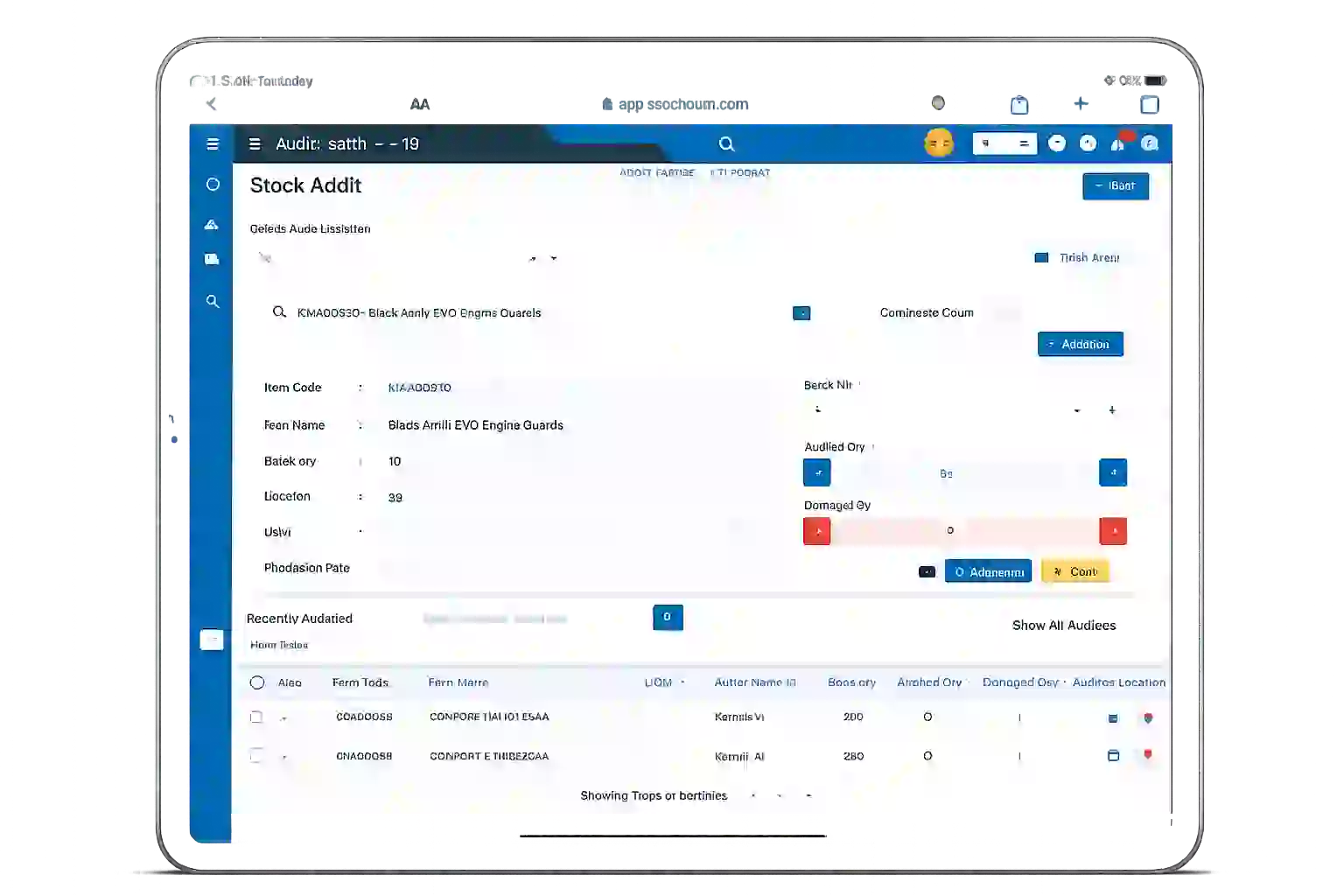
  • Mobile audit apps let counters work without paper tally sheets, with the count list, blind-count entry, and recount flag built into the same screen.
  • Centralized audit history answers the "who counted this and when" question instantly, which is essential for both internal investigation and external audit defense.
  • Multi-location visibility lets a head office see counts in progress across stores and DCs in real time, instead of waiting for end-of-week reconciliation.
  • ERP integration means approved adjustments push automatically with reason codes attached, eliminating the manual journal-entry step where errors get reintroduced after the count was already correct.

For chains and distributors running across multiple sites, the value of a platform like Stockount is less about any single feature and more about standardizing the cycle count workflow itself, the same count protocol, the same reason codes, the same audit trail, executed consistently across every location.

Multi-Location Cycle Counting: The Hidden Complexity

Single-site cycle counts are hard. Multi-site cycle counting inventory across a retail chain, a hypermarket group, or a distributor with several DCs introduces a different problem set entirely:

  • Protocol drift. Without enforcement, each location develops its own version of the count process. Reason codes mean different things. Recount thresholds differ. Comparing variance across locations becomes meaningless.
  • Visibility lag. Head-office controllers find out about variance days after the count, by which time the operational context is gone and the people who can explain it are off-shift.
  • Inconsistent escalation. A 5% variance at one store gets escalated; at another, it gets adjusted quietly. The aggregate variance number looks reasonable; the underlying signal is lost.
  • ERP reconciliation bottlenecks. Each location pushes adjustments on its own schedule, and central finance ends up reconciling fourteen separate sets of changes with no consistent timestamp.

The fix is structural, not motivational. A single counting platform, a single set of reason codes, defined thresholds enforced at the system level, and central visibility of every count in progress. This is the operational case for purpose-built audit software, not the marketing case, but the execution case.

Audit Readiness: Closing the Loop

The final test of a cycle count program is whether it holds up when an external auditor walks in. Audit-ready cycle counting has a few defining characteristics:

  • Every count has a named counter and a documented timestamp.
  • Every variance has a recount record before any adjustment was made.
  • Every adjustment has a reason code and a supervisor sign-off.
  • The trail from physical count → recount → adjustment → ERP entry can be traced end to end without piecing together emails.
  • The program has been running consistently month over month, not in fits and starts before audit season.

Operations teams that build this loop find that audits become a routine confirmation exercise instead of a multi-week scramble. The reconciliation work that used to happen at year-end is already done, day by day.

Frequently Asked Questions

Q1: What is a cycle count in a warehouse?

A cycle count in a warehouse is a recurring inventory check where a small portion of SKUs is counted on a rotating schedule — daily, weekly, or monthly — while normal warehouse operations continue. The goal is to keep ERP and WMS records aligned with physical stock without the disruption of a full annual inventory shutdown.

Q2: How do you do a cycle count step by step?

The standard warehouse cycle count process has ten steps: (1) select SKUs or zones, (2) freeze stock movement in the count zone, (3) snapshot the ERP quantity, (4) assign counters to zones, (5) count blind without seeing system numbers, (6) flag variances at the point of count, (7) run an independent recount on any flagged item, (8) investigate open transactions and overflow bins before adjusting, (9) post adjustments with documented reason codes, and (10) log the full audit trail.

Q3: How often should you cycle count inventory in a warehouse?

Cycle count frequency should follow the cost of inaccuracy. High-value, high-velocity (A-class) SKUs are typically counted weekly. Mid-tier B items are counted monthly. Low-velocity C items are counted quarterly. High-risk or regulated items may need daily verification. The total program should cover 100% of SKUs over a defined cycle — usually one fiscal quarter.

Q4: What is a good cycle count accuracy rate?

A cycle count accuracy rate of 95% is the minimum acceptable benchmark for most operations. World-class warehouses run at 97%+ inventory accuracy, and best-in-class fulfillment operations push toward 99% on order accuracy. According to CAPS Research, the average across surveyed organizations in 2024 was about 83% — meaning most warehouses have meaningful room to improve.

Q5: What is blind counting and why does it matter?

Blind counting is the practice of counting physical inventory without showing the counter the system quantity. It matters because seeing the expected number introduces confirmation bias, counters subconsciously adjust their count to match the system, masking real variance. Blind counting is the single most important discipline for reliable cycle count results.

Q6: What's the difference between cycle counting and a physical inventory?

A cycle count verifies a subset of inventory on a rolling schedule with no operational shutdown. A full physical inventory counts everything at once, usually requires a shutdown, and happens once a year. Cycle counting maintains accuracy continuously; a physical inventory only confirms accuracy on count day. For a full breakdown of the differences, see our [what is cycle count guide (https://www.stockount.com/articles/what-is-cycle-count).

Q7: What tools are used for cycle counting inventory?

Modern cycle counting inventory relies on barcode scanners or RFID readers, mobile audit apps for blind counting and real-time variance flagging, ERP/WMS integration for automated reconciliation, and audit-trail logging for compliance defense. Purpose-built inventory audit platforms like Stockount combine these into one workflow so counts, recounts, reason codes, and adjustments all live in the same system.

Q8: Can cycle counts be done during normal warehouse operations?

Yes, that's one of the main advantages of cycle counting over a full physical inventory. Cycle counts can be run during live warehouse operations by freezing only the count zone (not the whole warehouse), counting in 30–60 minute windows during low-traffic periods, and excluding any in-transit or in-receipt stock from the count.

From Reconciliation Crisis to Operational Routine

The teams that get cycle counting right don't run it as a separate workflow. They build it into the warehouse rhythm, short windows, scanned counts, immediate variance flagging, fast recounts, documented reason codes, monthly root-cause review. The counts become smaller, the variances become smaller, and the financial adjustments at month-end become a non-event.

If your team is still running cycle counts on paper tally sheets, end-of-shift spreadsheet entry, or monthly catch-up sessions, the workflow itself is generating most of the variance you're chasing. The mechanics aren't broken; the execution conditions are.

Stockount's inventory audit platform was built for this exact problem: real-time variance tracking, mobile cycle counting on the warehouse floor, automated audit trails, multi-location visibility, and ERP-ready reconciliation in a single workflow. If reducing stock discrepancies, simplifying recounts, and walking into audits without surprises sounds like the operational state you want, start a free 15-day trial — or book a demo to see how the workflow runs on a real warehouse floor.

Tags
Search For Articles
Latest Articles

Follow Us
Tags
Request a demo