How to Find the Root Cause of Inventory Variance: A Step-by-Step Guide
| By Stockount

Your system says you have 1,240 units. Your physical count says 1,191. That's a variance of -49 units.
Where did the 49 units go?
Most warehouse and inventory teams respond to a variance like this by recounting, and when the recount confirms the number, they log the adjustment and move on. The variance gets corrected. The cause gets ignored.
That's the problem.
Correcting the number only fixes today's record. It does nothing to prevent the same discrepancy from appearing again next week, next month, or across every cycle count going forward. Inventory root cause analysis is the process that changes this. Instead of accepting variances as a cost of doing business, it treats each discrepancy as evidence of something that went wrong, and works backward to find it.
This guide walks through exactly how to do that: what inventory variance is, why it happens, and a practical step-by-step process for identifying the root cause and preventing it from recurring.
What Is Inventory Variance?
Inventory variance is the difference between the stock quantity recorded in your inventory audit system and the quantity physically counted in your warehouse or store. A variance means your records and your reality don't match, and something caused that gap.
Variances can go in either direction:
| Variance Type | Definition | Example |
|---|---|---|
| Negative variance | Physical count is lower than system stock | System: 1,240 / Count: 1,191 / Variance: -49 |
| Positive variance | Physical count is higher than system stock | System: 800 / Count: 823 / Variance: +23 |
A negative variance typically points to stock loss, theft, misshipment, damaged product written off incorrectly, or goods received but not recorded. A positive variance often indicates receiving was logged twice, a return was added to inventory without being recorded in the system, or a previous count was understated.
Both types matter. Both require investigation.
Why Inventory Variances Matter
Inventory variances are not just a bookkeeping problem. They directly affect your ability to run operations, fulfill orders, and make purchasing decisions.
When your inventory records are inaccurate, the downstream consequences compound quickly:
- Stockouts occur when the system shows available stock that isn't actually there, causing missed sales or failed order fulfillment.
- Overstocking happens when phantom inventory inflates your available quantities, leading purchasing teams to under-order and then over-correct.
- Delayed fulfillment follows when warehouse teams spend time searching for stock that the system says exists but physically doesn't.
- Poor purchasing decisions result from replenishment triggers based on incorrect inventory levels.
- Audit failures become more likely when recurring variances signal weak inventory controls to finance teams and external auditors.
- Customer dissatisfaction is the end result — delayed shipments, cancelled orders, and substitutions caused by unreliable inventory data. A retail distribution centre that carries 12,000 SKUs with even a 2% variance rate has roughly 240 inaccurate stock records at any given time. That's 240 opportunities for something to go wrong before the next inventory audit catches it.
Common Causes of Inventory Variance
Inventory discrepancies don't appear at random. They trace back to specific moments in your inventory process where something was handled, counted, recorded, or moved incorrectly. Here are the most common causes.
Receiving Errors
When goods arrive at a warehouse or store, they need to be counted, inspected, and recorded accurately. Receiving errors occur when the quantity received doesn't match what's entered into the system, supplier delivers 95 units but the receiver logs 100, or a shipment arrives short and the shortage isn't documented at the point of receiving.
Picking Errors
Picking errors happen when warehouse staff pull the wrong quantity, the wrong SKU, or items from the wrong bin location. A picker who pulls 12 units instead of 10 creates a negative inventory variance for that SKU, even if the shipment was correct. Mis-picks are one of the most common causes of inventory count variance in high-volume operations.
Shipping Errors
Goods can leave your facility without being properly scanned or recorded. Unrecorded shipments, duplicate shipments, or shipments where the system records a different quantity than what was actually packed create immediate discrepancies between physical stock and system stock.
Inventory Transfer Mistakes
When stock moves between locations, between warehouses, between zones, or from storage to the shop floor, transfers need to be recorded in both the source and destination locations. An unrecorded or partially recorded transfer creates a phantom variance: the stock exists, but the system doesn't know where it is.
Data Entry Errors
Manual data entry introduces errors at every touchpoint. Transposed quantities, incorrect SKU selection, and duplicate entries all create stock discrepancies that have nothing to do with physical stock movement. These errors are particularly common in operations that haven't yet implemented barcode scanning or RFID for inventory tracking.
Inventory Shrinkage
Shrinkage covers stock loss from theft (internal or external), administrative errors, and supplier fraud. In retail environments, shrinkage is often the first explanation assumed when a variance is discovered, but it should be confirmed through root cause analysis, not assumed by default.
Damaged Stock
Damaged inventory that isn't immediately written off in the system creates an ongoing variance. A pallet damaged in transit, stock spoiled in storage, or items broken during picking need to be removed from system records at the time they're identified — not left in the count until the next audit.
Cycle Count Errors
The counting process itself introduces variance. Miscounts, double-counts, skipped locations, and counting the wrong product in a bin all create discrepancies that reflect counting errors rather than actual stock movement problems. Using blind counts (where the counter doesn't see the expected quantity) and requiring recounts when results fall outside tolerance reduces this risk.
Unauthorized Adjustments
Stock adjustments that aren't properly documented or approved create gaps in your audit trail. When anyone in the warehouse can adjust inventory records without a corresponding reason code, approval, or supporting transaction, it becomes impossible to trace the cause of a variance after the fact.
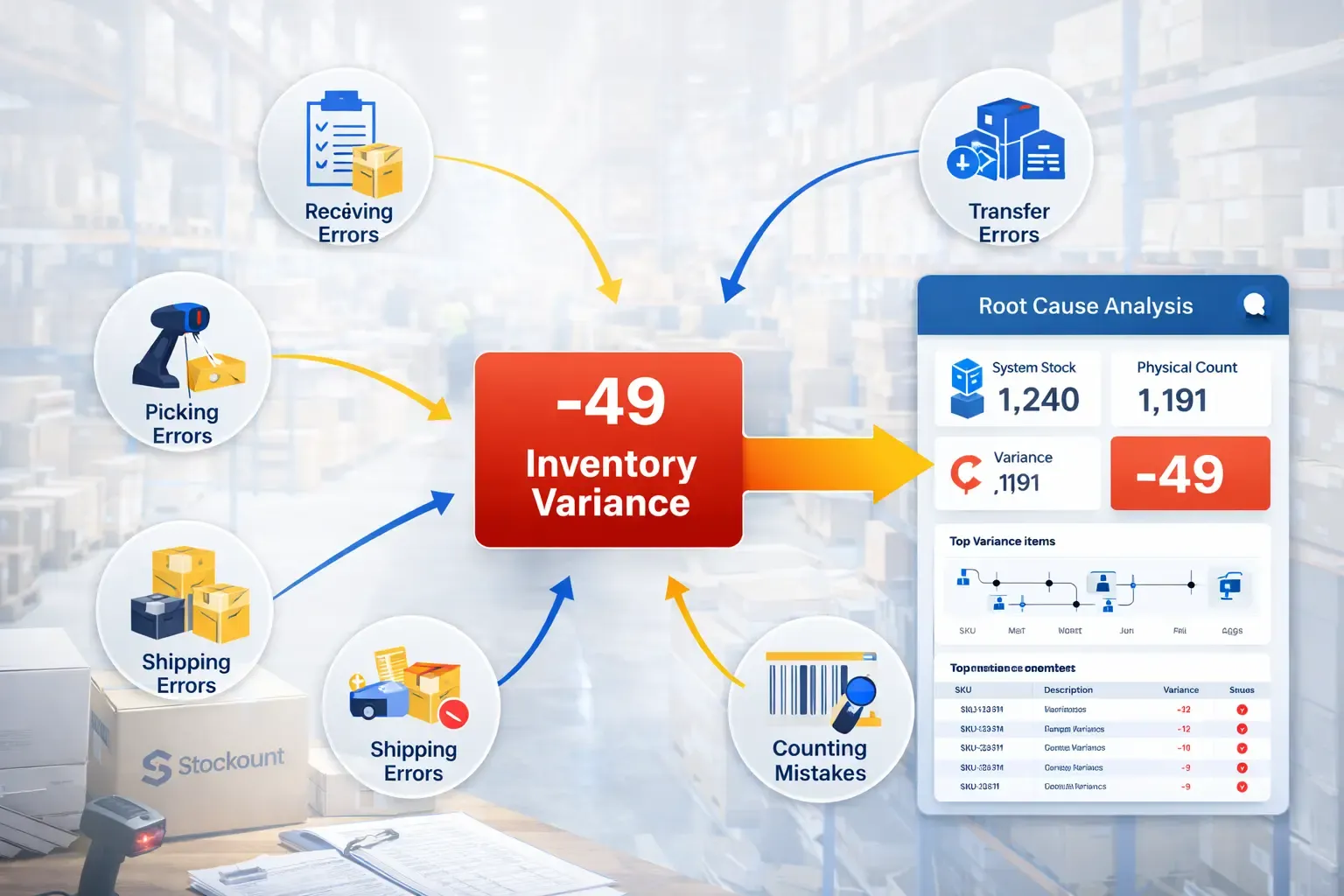
Found a Variance? The Hard Part Is Finding the Cause.
Most systems only tell you:
Expected Stock: 1,240
Actual Stock: 1,191
Variance: -49 They don't tell you:
Which transaction caused it
When it started
Who last handled the item
Whether it was a receiving, picking, transfer, or counting error
Whether the issue has happened before
Stockount connects inventory audits, cycle counts, stock movements, and adjustment history so teams can trace discrepancies back to their source and resolve them faster.
Step 1 – Verify the Variance
Before investigating the cause of a variance, confirm it's real. A counting error is the fastest thing to rule out — and a recount is cheaper than a full investigation.
How to verify:
- Assign a different counter to recount the affected SKU
- Use a blind count (don't show the expected quantity before counting)
- Check whether the bin location was counted correctly and no adjacent locations were missed
- If the variance is large, break the count into sections and recount each one separately If the recount confirms the variance, it's real proceed to investigation. If the recount produces a different number, investigate the counting process before assuming a stock movement problem.
For large warehouses, sampling methods can help prioritize which variances to investigate first. Focus investigation effort on high-value SKUs, high-velocity items, and any SKU that has shown a recurring pattern of variance across multiple cycle counts.
Step 2 – Review Inventory Movement History
Once you've confirmed the variance is real, pull the full transaction history for the affected SKU over the relevant period. Inventory movement history is the starting point for every variance investigation — it narrows the window from "something happened" to "here's the list of transactions where it could have happened."
Transaction types to review:
- Receipts — What was recorded as received, and when?
- Transfers — Did the SKU move between locations? Was the transfer fully recorded at both ends?
- Shipments — What quantities were recorded as shipped? Were there any cancelled or amended orders?
- Returns — Were any returned units added back to inventory? Were they recorded correctly?
- Adjustments — Were any manual stock adjustments made? What reason codes were used? Look for the point where system stock diverged from expected levels. If the last cycle count was accurate and the current count shows a variance, the cause lies somewhere in the transactions between those two points.
Step 3 – Investigate Receiving Activities
Receiving is one of the highest-risk touchpoints in the inventory process. Goods arrive in high volumes, under time pressure, and from multiple suppliers — and errors made at receiving flow directly into every downstream inventory record.
What to check in receiving:
- Supplier shortages — Compare the purchase order to the goods received note. Did the supplier ship less than ordered? Was the shortage documented?
- Receiving quantity errors — Were the units actually counted at receiving, or was the system updated based on the supplier's packing list without a physical count?
- Missing documentation — Are there receipts with no corresponding purchase order, or purchase orders with no corresponding receipt?
- Putaway errors — Was the stock received correctly but put away to the wrong bin location? If so, it exists in the warehouse but can't be found — creating a variance in the expected location. Cross-reference the supplier's delivery documentation with your receiving records for the period in question. Discrepancies between the two are often the origin of a negative inventory variance.
Step 4 – Analyze Picking and Shipping Records
If receiving records look accurate, the variance likely occurred downstream in picking, packing, or shipping. This step involves comparing what the system says was shipped against the actual picking and dispatch records.
What to look for:
- Mis-picks — Were units of the wrong SKU or wrong quantity pulled for an order? A mis-pick creates a variance in both the incorrectly picked SKU and the intended SKU.
- Wrong quantities shipped — Compare order quantities against packing slips and carrier manifests. Were the quantities on the packing slip consistent with what was physically shipped?
- Duplicate shipments — Was the same order shipped twice? Duplicate dispatch records are a source of negative variances that are easy to miss without systematic review.
- Unrecorded shipments — Were any goods removed from inventory without a corresponding shipment record in the system? This is worth checking if your facility handles will-call pickups, sample requests, or intercompany transfers that don't always follow the standard order process.
Step 5 – Review Audit and Cycle Count Data
Historical cycle count and audit data reveals patterns that individual transaction reviews miss. If a variance investigation isn't turning up an obvious cause in receiving or shipping records, step back and look at the history.
What to analyze:
- Historical variance trends for the SKU — Has this product shown recurring variances over multiple count periods? If so, the cause is likely systemic rather than a one-off error.
- Recurring variances by location — Is the variance concentrated in a specific bin, zone, or warehouse area? A particular location with repeated discrepancies often points to a labelling problem, a mis-location in the WMS, or a systematic picking error in that area.
- Problem SKUs — Which products appear most frequently in variance reports? High-velocity items, items stored in multiple locations, and items with similar packaging or barcodes to adjacent SKUs are common candidates.
- Frequency of adjustments — How often has this SKU been manually adjusted? A high adjustment frequency suggests the root cause has never been resolved — only corrected.
Step 6 – Perform Root Cause Analysis
With transaction history, receiving records, picking data, and historical count trends reviewed, you now have enough information to perform a structured root cause analysis. The goal is to move beyond identifying what went wrong to understanding why it went wrong, so the fix addresses the cause, not just the symptom.
Use this framework for every significant variance investigation:
What Happened?
State the variance clearly and specifically. "System shows 1,240 units. Physical count shows 1,191 units. Variance of -49 units confirmed across two independent recounts."
Where Did It Happen?
Identify the process step where the discrepancy originated. "Transaction review indicates the variance originated at receiving on [date]. The supplier delivered 951 units against a PO for 1,000 units. The receiving record shows 1,000 units received."
When Did It Happen?
Pinpoint the time window. "The variance was introduced between [date of receipt] and [date of next count]. No adjustments or transfers were recorded in this period."
Who Was Involved?
Identify the team members, roles, or systems involved in the transaction where the variance originated. This is not about blame — it's about identifying whether additional training, process clarification, or system access controls are needed.
Why Did It Happen?
Identify the root cause, not the surface cause. "The receiver updated the system from the supplier's packing list without performing a physical count of the delivery. The supplier's shortage was not identified at receiving and was not communicated to the purchasing team."
A practical example: A furniture retailer investigates a recurring negative variance for a high-velocity SKU. The root cause analysis reveals that the item is stored in two bin locations — a primary location and an overflow location — but the cycle count process only covers the primary location. The stock in the overflow location is never counted, creating a consistent under-count every period. The fix isn't a recount. It's updating the cycle count configuration to include both locations.
Signs Your Inventory Variance Problem Is Systemic
A one-time variance caused by a supplier shortage or a single picking error is a process exception. A variance that reappears consistently — across the same SKU, the same location, or the same team — is a systemic problem. Here's how to tell the difference.
Checklist: Signs of a systemic inventory variance problem
- The same SKU appears in variance reports across three or more consecutive count periods
- The same warehouse zone or bin location consistently shows discrepancies
- Manual stock adjustments are made frequently without root cause documentation
- Inventory reconciliation requires significant time at the end of each period
- Variances are corrected in the system but the same issues re-emerge
- No formal process exists for documenting the cause of each adjustment
- Cycle counts confirm variances but don't generate investigation follow-up
- The same receiving, picking, or shipping errors appear in multiple variance investigations
If three or more of these apply, the inventory variance problem goes deeper than individual errors. The investigation needs to move up a level — from individual transactions to the processes, systems, and training that govern how inventory is handled.
Best Practices to Prevent Future Inventory Variances
Preventing inventory variance is not about eliminating human error entirely. It's about building processes that catch errors early, create accountability, and generate the data needed to identify problems before they compound.
Barcode scanning at every touchpoint. Manual data entry is the single largest source of avoidable inventory errors. Implementing barcode scanning at receiving, picking, packing, and shipping removes most transcription errors from the process.
Regular cycle counting. Full physical inventory counts are disruptive and infrequent. A structured cycle count programme — counting a rotating subset of SKUs regularly — catches variances closer to their source, before the transaction trail goes cold.
Standardised receiving procedures. Every delivery should be physically counted against the purchase order before the system is updated. The supplier's packing list is a starting point for reconciliation, not a substitute for a count.
Documented inventory adjustments. Every manual adjustment should require a reason code, a supporting document, and manager approval above a defined threshold. Adjustments without documentation make root cause analysis impossible.
Real-time inventory tracking. The longer the gap between a variance occurring and it being detected, the harder it is to trace. Real-time visibility into stock movements reduces investigation time and improves accuracy.
Variance trend monitoring. Review variance data across periods — not just per count. Trend reports reveal recurring problems that individual count reviews miss.
Employee accountability and training. Inventory accuracy is a shared responsibility. Regular training on receiving procedures, picking protocols, and adjustment requirements, combined with visibility into accuracy rates by team and location, creates accountability without blame.
How Stockount Helps Teams Find the Root Cause of Inventory Variance
Finding the cause of an inventory variance requires connecting data that typically lives in separate places: cycle count results, receiving records, shipment logs, adjustment history, and audit reports. Pulling this together manually is slow — and in many operations, it doesn't happen at all.
Stockount is built for inventory teams who need to investigate discrepancies, not just record them.
✓ Identify where discrepancies occur — Stockount tracks variance by SKU, location, and count period, making it immediately visible which products and zones are generating the most discrepancies.
✓ Review inventory movement history — Every stock movement — receipts, shipments, transfers, returns, adjustments — is logged and searchable, so teams can reconstruct the transaction history for any SKU during any time window.
✓ Analyse audit results — Audit data is organised and accessible, not buried in spreadsheets. Teams can compare results across periods to identify trends without building custom reports.
✓ Monitor count variances — Cycle count results are tracked over time, with variance trends visible at the SKU and location level.
✓ Track adjustment activity — Every stock adjustment is logged with reason codes, approval status, and user information, creating a clear audit trail for every change.
✓ Identify recurring discrepancy patterns — Stockount surfaces repeat variances that indicate systemic problems, not one-off errors, so investigation effort is focused where it will have the most impact.
✓ Improve inventory accuracy — With the data to investigate and resolve variances properly, teams stop correcting the same discrepancies repeatedly and start eliminating the underlying causes.
✓ Reduce audit investigation time — What typically takes hours of manual cross-referencing takes minutes when all the relevant data is connected and searchable in one place.
✓ Create accountability across inventory processes — Stockount gives operations managers visibility into where variances originate, by process step, by team, by location, so accountability is grounded in data.
Frequently Asked Questions About Inventory Variance
Q1: What is inventory variance?
Inventory variance is the difference between the stock quantity recorded in your inventory management system and the quantity confirmed in a physical count. A negative variance means fewer units exist than the system shows; a positive variance means more units are present than recorded. Variances indicate that at least one inventory transaction — receiving, picking, shipping, transfer, or adjustment — was recorded inaccurately or not recorded at all.
Q2: What causes inventory variance?
Inventory variance is caused by errors or omissions at any point in the inventory process. The most common causes include receiving errors (wrong quantities logged at delivery), picking and shipping mistakes (incorrect quantities pulled or dispatched), inventory transfer mistakes (stock moved but not recorded), data entry errors, inventory shrinkage (theft or loss), damaged stock not written off in the system, counting errors during cycle counts, and unauthorized stock adjustments without proper documentation.
Q3: How do you find the root cause of inventory variance?
Start by verifying the variance with a recount. Then review the inventory movement history for the affected SKU — receipts, shipments, transfers, and adjustments — to identify where the discrepancy originated. Investigate receiving records, picking and shipping logs, and historical cycle count data. Use a structured root cause analysis framework (what happened, where, when, who was involved, and why) to identify the underlying cause rather than just the surface error.
Q4: What is the difference between inventory variance and inventory discrepancy?
Inventory variance refers specifically to the numerical difference between system stock and physical count — it's a measurement. Inventory discrepancy is a broader term describing any mismatch between records and reality, which may or may not have been quantified. In practice, the terms are often used interchangeably, but variance typically refers to the measured gap, while discrepancy describes the condition of inaccurate records more generally.
Q5: How can inventory variances be prevented?
Prevent inventory variances by implementing barcode scanning at every inventory touchpoint, running a regular cycle count programme, standardising receiving procedures to require physical counts before system updates, documenting every stock adjustment with reason codes and approvals, training staff on accurate inventory handling, and monitoring variance trends over time to identify recurring issues before they become systemic.
Q5: What are the most common inventory variance causes in warehouses?
In warehouse environments, the most common causes of inventory variance are picking errors (wrong SKU or quantity pulled), receiving discrepancies (supplier shortages not identified or recorded), unrecorded stock transfers between locations, manual data entry errors, cycle count mistakes, and inventory shrinkage. Operations with high SKU counts, multiple bin locations per SKU, and manual data entry processes are particularly vulnerable.
Q8: Why is inventory variance analysis important?
Inventory variance analysis is important because it reveals why discrepancies occur, not just that they occurred. Without analysis, teams correct the same variances repeatedly without improving accuracy. With analysis, teams identify the processes, locations, and SKUs generating the most variance — and fix the underlying causes. This reduces inventory losses, improves order fulfillment reliability, and creates the accurate stock records that purchasing, finance, and operations depend on.
Q9: How often should inventory variance be investigated?
Every confirmed variance above your defined tolerance threshold should be investigated at the time it's identified. For cycle counts, this means building investigation into the cycle count process rather than treating it as a separate step. Recurring variances — the same SKU or location appearing in multiple count periods — should be escalated to a full root cause analysis. Waiting until a periodic full audit to investigate variances allows the transaction trail to go cold and makes root cause identification much harder.
Q10: What is inventory root cause analysis?
Inventory root cause analysis is a structured process for identifying why an inventory variance occurred, not just what the variance is. It involves verifying the variance, reviewing transaction history, investigating specific process steps (receiving, picking, shipping, transfers), and using a systematic framework to trace the discrepancy back to its origin. The goal is to identify a correctable cause, a process gap, a training need, a system configuration issue, that, when addressed, prevents the same variance from recurring.
Q11: How does Stockount help identify inventory variance root causes?
Stockount connects inventory audit results, cycle count data, stock movement history, and adjustment logs in one platform, giving teams the visibility to investigate variances without manually pulling data from multiple systems. Teams can review the full transaction history for any SKU, identify recurring discrepancy patterns by product and location, and track adjustment activity with a complete audit trail. This reduces investigation time and makes it practical to perform root cause analysis on every significant variance, not just the largest ones.
Stop Finding Variances. Start Finding Answers.
Finding an inventory variance is easy. Your next cycle count will surface one.
Understanding why it happened is what actually improves inventory accuracy.
Stockount gives inventory teams visibility into:
✓ Every count
✓ Every stock movement
✓ Every adjustment
✓ Every audit result
✓ Every variance trend
✓ Every inventory exception
Instead of spending hours searching through spreadsheets and transaction logs, teams can quickly investigate discrepancies, identify recurring issues, and take corrective action before the same variance appears in the next count.
Inventory variances don't fix themselves.
Track every count, movement, adjustment, and audit in one place to quickly uncover the source of discrepancies.
Key Takeway
Inventory variance is the gap between what your system says you have and what's actually on the shelf. It happens in every warehouse and every distribution operation — because inventory processes involve many people, many transactions, and many opportunities for things to go slightly wrong.
The difference between operations that manage inventory well and those that don't isn't the absence of variances. It's what they do when variances appear. Investigating the cause, documenting the finding, and fixing the underlying process is what prevents the same discrepancy from recurring.
The goal isn't to correct inventory variances. The goal is to eliminate the causes behind them.