The Ultimate Guide to Inventory Count & Stock Audits
| By Stockount

Inventory Count Guide: How to Count Stock Easily and Avoid Mistakes
Inventory count is important for any business that handles stock. But many companies still rely on outdated methods like manual counting or spreadsheets. This often leads to errors, stock mismatches, and even audit failures.
If your business is struggling with inventory count, you're not alone. The good news? Switching to a modern inventory audit system can make a huge difference.
This guide will show you how to count inventory easily, avoid mistakes, and use the right tools to save time.
What Is Inventory Count?
Inventory count (also called stock counting or stock-taking) means checking the actual items you have in stock.
It helps you make sure your system shows the same numbers as the real stock in your store or warehouse.
A well-executed inventory count helps businesses:
- Maintain accurate stock levels
- Prevent losses and shrinkage
- Improve financial reporting
- Ensure audit compliance
Why Inventory Count Is Important
Ignoring proper inventory counting can create serious operational and financial risks.
Key Risks of Poor Inventory Count:
- Stock discrepancies between the system and physical inventory
- Revenue leakage due to theft or shrinkage
- Audit failures and compliance issues
- Overstocking or stockouts
- Poor demand forecasting
Switching to modern inventory audit software with real-time tracking can help businesses reduce errors by as much as 70% and ensure operations run with greater efficiency.
Types of Inventory Count Methods
Picking the right inventory count method depends on your business size, SKU volume, and operational setup.
1. Periodic Inventory Count
This method involves counting all stock at fixed times, such as monthly or yearly.
Pros:
- Simple to implement
- No advanced tools required
Cons:
- Time-consuming
- Disrupts operations
- Higher risk of errors
2. Perpetual Inventory System
A perpetual system updates stock levels in real time using barcode scanning and inventory management systems.
Pros:
- Real-time inventory visibility
- Reduced audit workload
- High accuracy
Cons:
- Requires investment in inventory audit software
3. Cycle Counting
Cycle counting involves counting small portions of inventory instead of all items at once.
Pros:
- Continuous accuracy
- No disruption to operations
- Ideal for large warehouses
Cons:
- Requires planning and discipline
4. ABC Inventory Counting
This method categorizes inventory based on importance:
- A items: High value, counted often
- B items: Medium value
- C items: Low value, counted less often
This approach improves efficiency and focuses on critical inventory.
Step-by-Step Inventory Count Process
A structured inventory count process ensures accurate results and audit readiness.
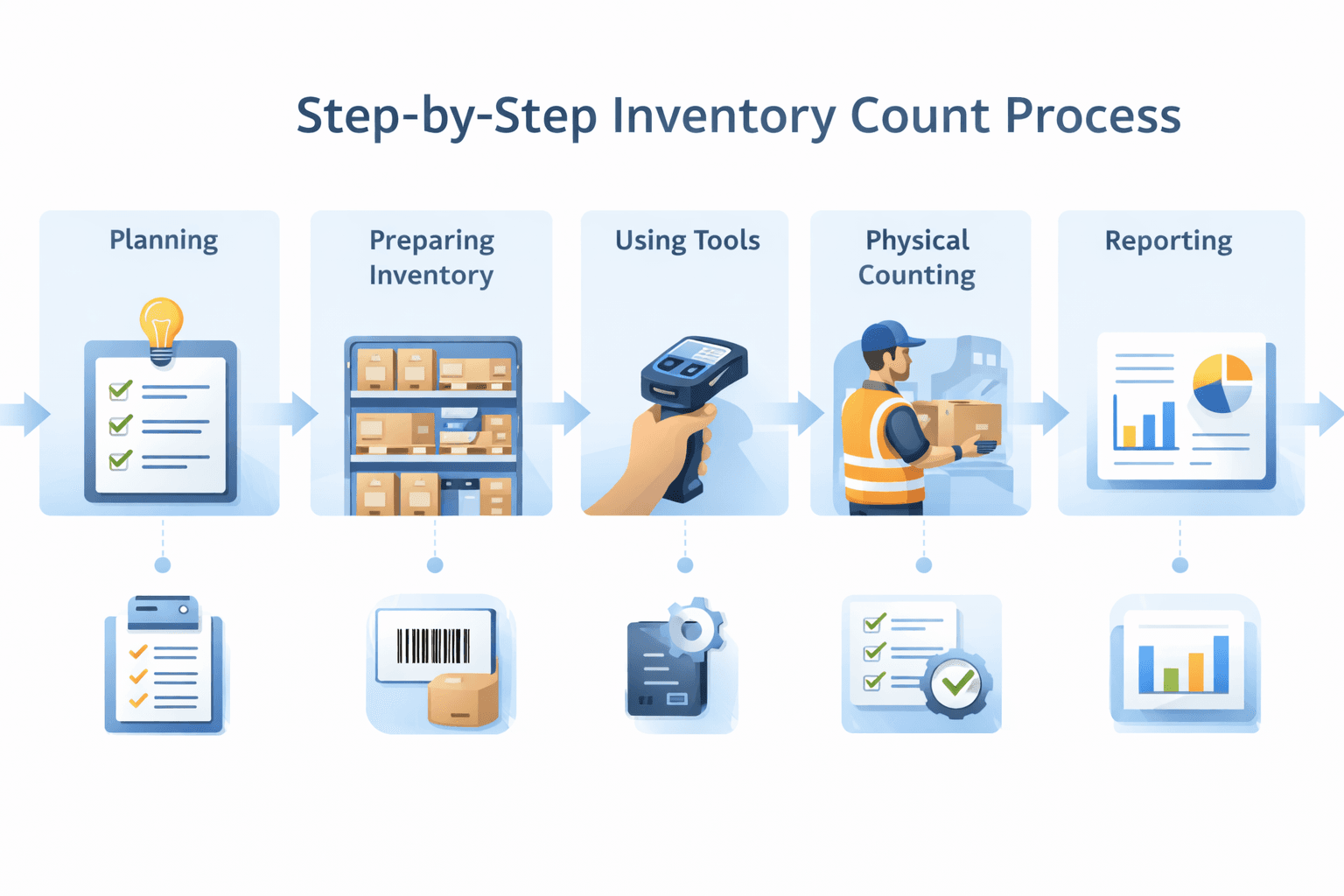
Step 1: Plan Your Inventory Count
- Define scope (warehouse, store, SKUs)
- Assign roles and responsibilities
- Schedule counts during low-activity hours
Step 2: Prepare Inventory
- Organize stock by bins/locations
- Use clear labels for all SKUs
- Pause inventory movement if needed
Step 3: Use the Right Tools
- Barcode scanners
- Inventory counting software
- Mobile inventory apps
Step 4: Perform Physical Count
- Count using a systematic approach
- Use double verification
- Record discrepancies immediately
Step 5: Reconcile Differences
- Compare physical vs system stock
- Identify root causes
- Adjust records accurately
Step 6: Generate Reports
- Stock variance reports
- Audit logs
- Performance insights
Common Inventory Count Challenges
Even experienced teams face issues during stock audits.
Major Challenges:
- Human Errors: Manual counting mistakes
- Data Delays: Lag in updating systems
- Poor Storage Management: Misplaced items
- Stock in Transit: Missing moving inventory
- Expired/Damaged Stock: Incorrect inclusion
A good physical inventory audit tool can solve many of these problems.
Advanced Inventory Count Strategies
To further improve accuracy, businesses can adopt advanced strategies.
Blind Counting
- Counters don’t see system quantities
- Ensures unbiased counting
- Ideal for audits
Zone-Based Counting
- Divide warehouse into zones
- Assign teams to each section
- Improves accountability
Tag Counting
- Tag counted items
- Prevent duplicate counting
- Useful for large inventories
Tools to Improve Inventory Count
Modern tools are essential for efficient inventory counting.
Inventory Audit Software
- Real-time stock updates
- Automated reconciliation
- Multi-location tracking
Barcode & QR Code Scanners
- Faster counting
- Reduced human error
Mobile Inventory Apps
- Count using smartphones
- Instant data synchronization
Cloud-Based Systems
- Access inventory anywhere
- Real-time dashboards
Using smart inventory counting software can drastically improve accuracy and speed.
Inventory Audit Checklist
Before every inventory count, ensure the following:
- Inventory locations are organized
- SKU labels verified
- Counting team assigned
- Tools tested (scanners/apps)
- Inventory movement paused
- Backup data available
Best Practices for Accurate Inventory Count
- Adopt Real-Time Inventory Tracking – Avoid spreadsheets and use instant updating systems
- Use Cycle Counting – Regular smaller counts reduce errors
- Train Your Team – Ensure staff understand procedures and tools
- Use Double Verification – Two-person verification improves accuracy
- Track Inventory Movement – Monitor inbound, outbound, and adjustments
- Analyze Stock Variances – Identify discrepancy patterns to prevent future issues
Inventory Count Across Industries
Retail
- Focus on fast-moving products
- Frequent cycle counts
Warehouses
- Use barcode systems
- Optimize bin locations
Pharmacies
- Track expiry dates
- Ensure compliance
Distribution
- Track multi-location inventory
- Monitor stock in transit
How Technology Is Transforming Inventory Count
Modern businesses are moving from manual stock counts to automated inventory audit systems.
Key Trends:
- AI-driven inventory tracking
- Real-time dashboards
- Automated reconciliation
- Predictive stock insights
These technologies reduce audit time, improve decision-making, and enhance inventory accuracy.
Wrap-Up
Inventory count is not just an operational task; it’s a vital business function. It directly affects profitability, efficiency, and customer satisfaction.
Businesses that rely on manual processes often face stock discrepancies, audit failures, and lost revenue. By adopting a modern inventory audit system, using cycle counting, and implementing the right tools, companies can significantly improve accuracy and efficiency.
Inventory management systems and counting software provide real-time visibility, speed up audits, and strengthen overall stock control.
People Also Ask
1. How do you do an inventory count step by step?
Start by planning the count, organizing your stock, and assigning a team. Then count items systematically, record the data, compare it with your system, and fix any differences.
2. What is the difference between inventory count and stock audit?
Inventory count is simply counting physical stock. A stock audit goes further by checking accuracy, identifying errors, and ensuring compliance.
3. What is the easiest way to count inventory?
The easiest way is to use barcode scanners and inventory counting software. These tools speed up the process and reduce manual errors.
4. Why does inventory not match system records?
Inventory mismatches happen due to manual errors, theft, damaged goods, misplaced items, or delays in updating the system.
5. How can I make inventory counting faster?
You can speed up inventory counting by using barcode scanning, mobile apps, cycle counting, and real-time inventory systems.