7 Best Retail Inventory Audit Software Solutions for Accurate Stock Counts
| By Stockount
Inventory accuracy is one of the few operational levers a retailer controls directly. When physical stock and system records drift apart, the result is predictable: ghost stock that triggers false reorders, stockouts that send shoppers to a competitor, and shrinkage that quietly erodes margin every month it goes undetected.
Manual counting was never built for this. Clipboards and spreadsheets buckle under multi-location complexity, and by the time a variance report reaches a manager, the stock position has already changed. That's the gap retail inventory audit software is designed to close, mobile barcode scanning, real-time reconciliation, and centralized reporting that turns a slow annual event into a continuous, low-effort process.
This guide compares seven retail inventory audit software platforms so you can shortlist the right one for your store count, SKU volume, and budget.
Quick Answer: The best retail inventory audit software solutions right now are Stockount, Sortly, Finale Inventory, inFlow Inventory, Fishbowl Inventory, Zoho Inventory, and Cin7. Stockount is best for multi-location audit-first workflows, Sortly for small retailers needing simple visual tracking, and Cin7 for growing omnichannel operations that need warehouse automation alongside stock audits.
What Is Retail Inventory Audit Software?
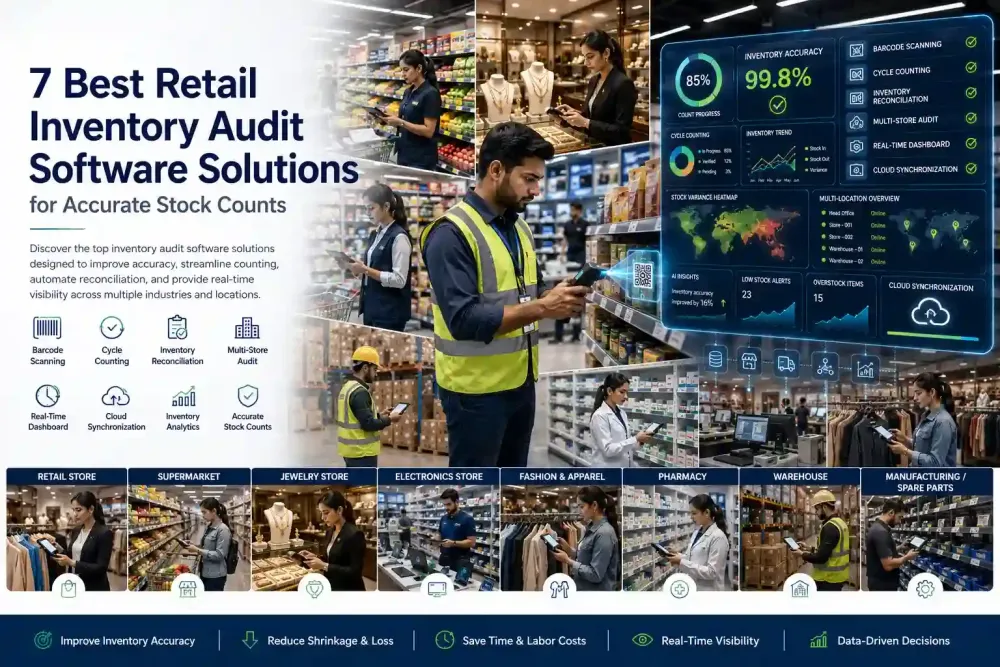
Retail inventory audit software replaces paper count sheets and manual spreadsheet reconciliation with mobile devices, barcode or QR scanning, and cloud dashboards that validate counts as they happen. Instead of waiting days for a consolidated report, discrepancies surface the moment a scanned quantity doesn't match the system record.
Most platforms in this category combine three core capabilities: barcode scanning to eliminate manual data entry errors, cycle counting to spread audits across the year instead of one disruptive event, and inventory reconciliation to compare physical counts against system-of-record data and generate an auditable variance trail. For a deeper look at how this process works end to end, see our guide to retail audits.
How We Selected These Software Solutions
We evaluated each platform against the criteria that matter most for a retail stock audit: barcode scanning support, offline counting capability, cycle counting workflows, inventory reconciliation and variance reporting, mobile app quality, reporting depth, ERP/POS integrations, ease of use, and publicly available pricing. Feature and pricing details below are based on vendor sites and independent review platforms at the time of writing — always confirm the latest specifics directly with each vendor before buying, since plans and tiers change over time.
Top 7 Retail Inventory Audit Software Solutions
1. Stockount
Overview: Stockount is a mobile-first inventory audit and stock-counting platform built specifically around the audit workflow cycle counts, ad-hoc audits, and cross-location reconciliation rather than general-purpose inventory management bolted onto an audit feature.
Key features: Dynamic and static audit modes, ad-hoc and investigation audits, cross audits, device camera and external scanner support, continuous count mode, serial/batch/unit tracking, offline mobile and tablet auditing, multi-user counting, real-time variance dashboards, and multi-branch reporting. It integrates with Zoho, Odoo, and custom ERPs via API rather than replacing your existing accounting or ERP system.
Pros: Purpose-built for audits rather than general inventory management; strong multi-location dashboard; offline-capable mobile app; works alongside existing ERPs.
Cons: Newer entrant with a smaller review footprint than long-established players; best suited to teams whose primary need is audit and reconciliation rather than full order/purchasing management.
Best for: Multi-location retailers, distributors, and manufacturers that need frequent, structured stock audits layered on top of an existing ERP or accounting system.
Pricing: Tiered plans with a free trial; check Stockount's pricing page for current rates.
2. Sortly
Overview: Sortly is a visual, photo-based inventory tracker popular with small retailers and field teams who want simple stock visibility without a steep learning curve.
Key features: Mobile barcode and QR scanning, custom folders and fields, photo-based item records, low-stock alerts, and exportable activity reports.
Pros: Very easy to onboard; strong visual organization; useful free tier for small operations.
Cons: Several reviewers report barcode scanning reliability issues and reporting depth that's limited compared to audit-specific tools; pricing rises noticeably at higher tiers.
Best for: Small, single- or few-location retailers with straightforward stock-tracking needs rather than complex reconciliation workflows.
Pricing: Free plan (1 user, 100 items); paid plans reportedly start around $49/month, with higher tiers around $149/month. Confirm current pricing on Sortly's site.
3. Finale Inventory
Overview: Finale Inventory (now operating under Descartes) is a cloud inventory management platform aimed at multi-channel retailers and e-commerce sellers who need inventory accuracy across many sales channels at once.
Key features: Multiple barcode configurations, lot and serial tracking, multi-location support, restock forecasting based on sales velocity, and stock auditing with historical stock-take reports.
Pros: Strong multi-channel sync (Shopify, Amazon, QuickBooks); flexible barcode setup; scales to high SKU/order volumes.
Cons: No native iOS barcode scanning support (Android only); published pricing varies across sources, so it's worth getting a direct quote.
Best for: Retailers selling across multiple online and offline channels who need inventory accuracy tied closely to order fulfillment.
Pricing: Reported starting prices range from roughly $99 to $499/month depending on the source and plan tier — confirm directly with Finale/Descartes.
4. inFlow Inventory
Overview: inFlow positions itself between simple tools like Sortly and complex ERPs like Cin7, aimed at small wholesalers and distributors who need purchase order and B2B ordering support alongside stock control.
Key features: Barcode scanning via smartphone camera or a dedicated handheld Smart Scanner, purchase order workflows, a B2B customer ordering portal, and around 38 built-in reports.
Pros: Clean purchase-order-to-receiving workflow; B2B showroom portal included on mid-tier plans; transparent per-tier pricing.
Cons: No free plan; manufacturing support is limited to basic assemblies; no direct native Amazon or eBay integration.
Best for: Small wholesalers and distributors that need solid purchase order management alongside inventory counting.
Pricing: Plans reportedly range from roughly $110 to $355/month across tiers (Entrepreneur through Mid-size), with custom Enterprise pricing above that — verify current tiers on inFlow's pricing page.
5. Fishbowl Inventory
Overview: Fishbowl serves manufacturers and warehouse-heavy operations that need inventory management tied closely to production — bills of materials, work orders, and QuickBooks synchronization.
Key features: Multi-location tracking, barcode scanning, serial/lot tracking, bill of materials and work order management, and cycle counting.
Pros: Deep QuickBooks/Xero integration; strong manufacturing and warehouse feature set; flexible module selection.
Cons: Pricing structures differ significantly between Fishbowl's cloud subscription plans and its separate on-premise/cloud-hosted "Advanced" product, and several reviewers cite added costs for custom reports and support contracts — get an itemized quote before committing.
Best for: Manufacturers and distributors that need inventory audit capability bundled with production and warehouse management.
Pricing: Cloud plans reportedly start in the $300–$400/month range; the separate on-premise Advanced product is quoted individually. Confirm directly with Fishbowl.
6. Zoho Inventory
Overview: Zoho Inventory is a budget-friendly, cloud-based platform aimed at small to mid-sized retailers and e-commerce sellers already using or open to the wider Zoho ecosystem (Books, CRM).
Key features: Barcode and RFID support, multi-warehouse tracking with transfers, batch and serial tracking, and integrations with Shopify, Amazon, eBay, and Zoho Books.
Pros: Genuinely usable free tier; affordable paid plans; clean, easy-to-learn interface.
Cons: Order volume caps on lower tiers; batch/serial tracking configuration can get complex; advanced automation is gated behind higher-tier plans.
Best for: Small to mid-sized retailers and e-commerce sellers who want an affordable, easy-to-learn platform, especially if already using Zoho Books or CRM.
Pricing: Free tier available; paid plans reportedly range from roughly $39 to $299/month depending on tier and order volume — confirm current limits on Zoho's pricing page.
7. Cin7 (Core)
Overview: Cin7 Core is a comprehensive inventory and warehouse management platform aimed at growing retailers, wholesalers, and manufacturers who need automation across sales channels, warehouses, and accounting in one system.
Key features: Mobile barcode scanning with guided picking, scan-to-verify accuracy checks, full and cycle stocktakes with serial/batch support, and demand forecasting tools.
Pros: Broad integration ecosystem (200+ tools); strong warehouse management and picking accuracy features; scales from SMB to more complex omnichannel operations.
Cons: Steeper learning curve than simpler tools; some reviewers report a complex pricing structure with recent price increases.
Best for: Growing multi-channel retailers and wholesalers that need inventory auditing bundled with broader warehouse and order management.
Pricing: Reportedly starts around $349/month (Standard), rising through Pro ($599) and Advanced ($999) tiers, with custom Omni pricing for larger operations. Confirm directly with Cin7.
Comparison Table
| Software | Barcode Scanning | Offline Mode | Cycle Counting | Inventory Reconciliation | Mobile App | Best For |
|---|---|---|---|---|---|---|
| Stockount | Yes | Yes | Yes | Yes | Yes | Multi-location audit-first workflows |
| Sortly | Yes | Yes (basic) | Limited | Basic | Yes | Small retailers, simple tracking |
| Finale Inventory | Yes | Limited (Android) | Yes | Yes | Android only | Multi-channel e-commerce sellers |
| inFlow Inventory | Yes | Limited | Yes | Yes | Yes | Small wholesalers/distributors |
| Fishbowl Inventory | Yes | Depends on plan | Yes | Yes | Yes | Manufacturers, production-linked audits |
| Zoho Inventory | Yes (+RFID) | Limited | Yes | Yes | Yes | Budget-conscious SMB retailers |
| Cin7 (Core) | Yes | Depends on plan | Yes | Yes | Yes | Growing omnichannel retailers |
Not Sure Which Platform Fits Your Store Count?
Stockount is purpose-built for the audit workflow — mobile barcode scanning, offline counts, and multi-location variance reporting layered on top of your existing ERP or POS.
Features to Look for in Retail Inventory Audit Software
Barcode scanning eliminates the transcription errors that come with handwritten counts. Offline counting matters for stockrooms and basement storage with poor connectivity the app should queue scans locally and sync once reconnected. Cycle counting lets you audit a rotating subset of SKUs continuously instead of closing the store once a year. Inventory reconciliation should flag variances automatically against a configurable threshold rather than requiring a manual spreadsheet comparison. For multi-location retailers, look for multi-location support that consolidates all stores into one dashboard rather than fragmented per-store exports. Finally, confirm the platform integrates with your existing ERP or POS (Zoho, Tally, SAP, QuickBooks, Odoo) so audit data doesn't live in a silo.
Why Stockount Stands Out
Where general-purpose inventory tools treat auditing as one feature among many, Stockount is built around the audit workflow itself. It supports mobile barcode scanning from any device, offline audits for connectivity-poor areas, structured cycle and ad-hoc counting modes, and real-time variance detection with drill-down reporting across every store location. It's designed to sit alongside your existing ERP or POS — Zoho, SAP, Tally, QuickBooks, Odoo — rather than replace it, and can typically be deployed and running its first audit within days rather than weeks. For retail operations where the main pain point is stock accuracy and reconciliation speed rather than full order management, that focus is the differentiator.
Frequently Asked Questions
Q1: What is the best software for retail inventory audits? There's no single best option for every retailer. Stockount is best for multi-location, audit-focused workflows layered on an existing ERP. Sortly suits small, single-location retailers wanting simple visual tracking. Cin7 and Fishbowl fit growing or manufacturing-linked operations that need broader warehouse automation, while Zoho Inventory and inFlow are strong budget-friendly picks for SMB retailers and wholesalers.
Q2: How much does retail inventory audit software cost? Pricing varies widely by platform and scale. Entry-level plans run roughly $0–$50/month (Sortly, Zoho Inventory's free and starter tiers), mid-tier platforms like inFlow and Finale run roughly $100–$500/month, and warehouse-heavy platforms like Cin7 and Fishbowl typically start around $350–$400/month and scale higher with users and modules. Always confirm current pricing directly with each vendor, since tiers and limits change frequently.
Q3: Is retail inventory audit software worth it for a single-store retailer? For a single location with a low SKU count and infrequent audits, a disciplined manual checklist can still work. Once you're auditing weekly or monthly, managing more than a few hundred SKUs, or want to eliminate manual counting errors, software pays for itself quickly through labor savings and better shrinkage detection.
Q4: Does retail inventory audit software work offline? Many platforms, including Stockount, support offline mobile scanning for stockrooms or basements with poor connectivity, syncing counts once the device reconnects. Offline support varies by vendor and plan, so confirm this specifically if your store has known dead zones.
Q5: Can I use retail inventory audit software alongside my existing ERP or POS? Yes. Most platforms in this category, including Stockount, are designed to integrate with (not replace) systems like Zoho, SAP, Tally, QuickBooks, Odoo, or Dynamics 365, syncing verified counts back into your system of record rather than becoming a separate source of truth.
Q6: What's the difference between inventory management software and inventory audit software? Inventory management software (like Zoho Inventory or Cin7) handles day-to-day stock tracking, purchasing, and order fulfillment. Inventory audit software focuses specifically on the count-and-reconcile process — verifying physical stock against system records and surfacing variances. Some platforms, like Stockount, specialize in the audit layer; others, like Cin7 and Fishbowl, bundle audit features inside a broader inventory management suite.
Conclusion
There's no single "best" retail inventory audit software the right choice depends on whether your priority is audit-specific workflows (Stockount), simple visual tracking (Sortly), multi-channel e-commerce sync (Finale), B2B wholesale ordering (inFlow), production-linked inventory (Fishbowl), budget-friendly SMB tools (Zoho Inventory), or broad omnichannel automation (Cin7). Match the platform to your SKU volume, store count, and existing ERP setup before you commit to a plan.
See Stockount Running Against Your Own Stock Data
Frequent, accurate audits across multiple locations shouldn't require choosing between speed and accuracy. Talk to an inventory specialist about your store count, SKU volume, and current ERP — no generic pitch, just your numbers.
Book a Free Demo → · Start Your Free Trial — No Card Required →