Inventory Audit vs Cycle Count: Which Process Does Your Business Need?
| By Stockount
Your ERP shows 1,000 units in stock. Your warehouse team counts and finds 940. Sixty units are unaccounted for, and now you have a decision to make. Do you run a full inventory audit, or is this a case for a cycle count?
Most operations teams have faced this exact moment, and most have made the wrong call at least once, either launching a disruptive, all-hands physical count for a discrepancy that a routine cycle count would have caught weeks earlier, or relying on spot checks when what the business actually needed was a comprehensive audit trail for compliance or financial reporting.
Inventory accuracy isn't a back-office detail. It directly affects order fulfillment, purchasing decisions, replenishment timing, customer service commitments, and the financial statements your leadership signs off on. When stock counts are wrong, promises to customers get broken, working capital gets tied up in phantom inventory, and every downstream decision, from reordering to production planning, is built on bad data.
Inventory audits and cycle counts are both tools for closing that gap between what your system says and what's actually on the shelf. But they solve different problems, on different timelines, for different reasons. Understanding which one your business needs right now, and how to run either one without draining a week of operational bandwidth, is what this guide covers.
Inventory Audit vs Cycle Count: What's the Difference?
Inventory Audit
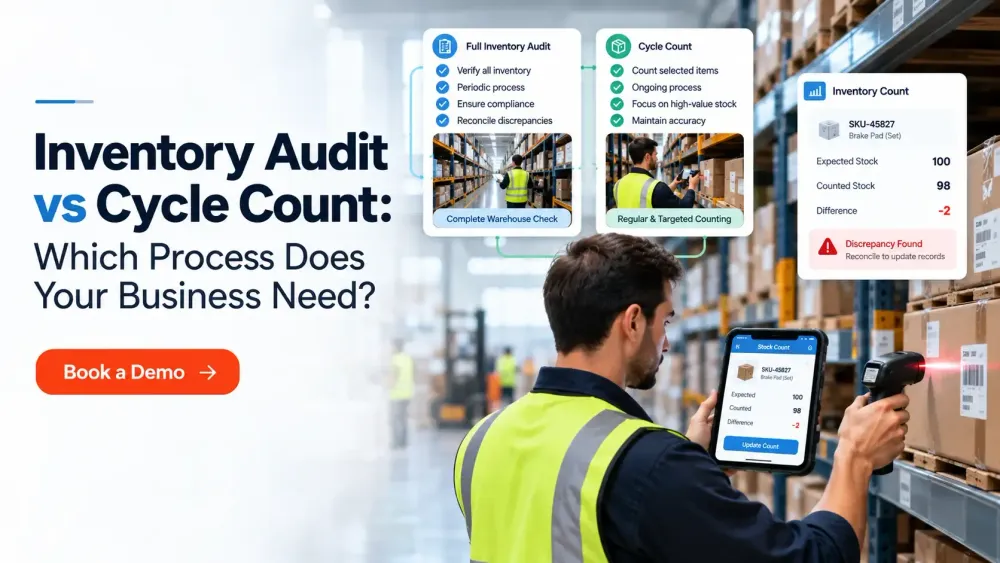
An inventory audit is a comprehensive, point-in-time verification of your entire stock every SKU, every location, reconciled against system records in one coordinated exercise.
- Purpose: To establish a definitive, verified position of all inventory at a specific moment — typically for financial reporting, compliance, insurance, or after a major operational event.
- Scope: Full inventory, across all warehouses, locations, or store floors.
- Frequency: Periodic — commonly annual, quarterly, or triggered by a specific event (ERP migration, ownership change, statutory requirement).
- Physical vs system verification: Every physical unit is counted and matched against system quantities.
- Discrepancy identification: Surfaces the complete picture of variances across the entire inventory base, not just selected items.
- Reconciliation: Formal, documented reconciliation of every discrepancy found.
- Documentation & accountability: Produces an audit trail — sign-offs, variance reports, and records that finance, auditors, or leadership can rely on.
Cycle Count
A cycle count is a recurring, partial inventory check — counting a subset of SKUs on a rolling schedule so the entire inventory gets verified over time, without stopping operations.
- Purpose: Ongoing accuracy maintenance — catching and correcting discrepancies continuously, before they compound.
- Scope: Selected inventory — often grouped by ABC classification, location, or risk profile, rather than everything at once.
- Frequency: Continuous and recurring — daily, weekly, or monthly, depending on item velocity and value.
- ABC classification: High-value or fast-moving "A" items get counted more often than low-value "C" items — concentrating effort where risk is highest.
- Operational disruption: Minimal — cycle counts run alongside normal warehouse activity rather than pausing it.
- Continuous verification: Because counts happen constantly, discrepancies are caught early, rather than discovered months later during a full audit.
These two processes are related, not interchangeable. A strong inventory accuracy program typically uses cycle counts as the day-to-day discipline that keeps stock reliable, with periodic inventory audits as the formal checkpoint that verifies the whole picture and satisfies compliance or reporting needs.
Inventory Audit vs Cycle Count — Key Differences
| Factor | Inventory Audit | Cycle Count |
|---|---|---|
| Primary purpose | Full verification for compliance, finance, or major events | Ongoing accuracy maintenance |
| Scope | Entire inventory, all locations | Selected SKUs or locations, rotating |
| Frequency | Periodic (annual, quarterly, event-driven) | Continuous (daily, weekly, monthly) |
| Inventory covered | 100% of stock in one exercise | A defined subset per cycle |
| Typical use case | Year-end close, ERP migration, statutory audit | Day-to-day stock accuracy, high-value item monitoring |
| Discrepancy detection | Comprehensive, but delayed until the audit runs | Early and continuous |
| Operational disruption | High — often requires a full or partial shutdown | Low — runs alongside normal operations |
| Reconciliation | Formal, documented, audit-grade | Ongoing, incremental |
| Best suited for | Finance, compliance, leadership reporting | Warehouse, inventory, and operations teams |
| Software support | Structured audit workflows, sign-off trails | ABC-based scheduling, mobile counting, real-time variance alerts |
Why Inventory Accuracy Becomes Difficult as Operations Grow
Inventory accuracy problems rarely show up when a business is small. They show up when the business scales — and by then, the cost of getting it wrong has scaled too.
As operations grow, several pressures compound:
- More SKUs mean more opportunities for miscounts, mismatched units of measure, and lookup errors.
- More warehouse locations make a single, unified view of stock harder to maintain — especially when each site runs its own process.
- Faster inventory movement shrinks the window in which a manual count is still accurate by the time it's finished.
- Manual counting and spreadsheet dependency introduce transcription errors, version-control chaos, and no real audit trail.
- Barcode errors, duplicate counts, and missed items are common when counting is paper-based or loosely supervised.
- Delayed reconciliation means discrepancies sit unresolved for weeks, masking the real cause.
- Poor audit visibility makes it hard for managers to know which locations, categories, or counters are driving the variance.
- Inventory transfers, batch and serialized stock add complexity that spreadsheets simply aren't built to track.
- Lack of real-time visibility means decisions — purchasing, replenishment, allocation — are made on stale numbers.
None of these problems are solved by working harder within a manual process. They're solved by moving to a structured, digital workflow that captures counts accurately the first time, flags variances immediately, and gives every location the same standard process to follow — whether that's a scheduled cycle count or a full inventory audit.
When an Inventory Audit Is the Right Choice
An inventory audit makes sense when you need a definitive, all-inventory position — not an ongoing accuracy check. Common triggers include:
- Periodic comprehensive verification — annual or quarterly checks required by management or ownership.
- Year-end inventory verification — closing the books with a confirmed stock position for financial statements.
- Compliance requirements — statutory audits, insurance valuations, or industry-specific regulatory checks.
- Major stock discrepancies — when cycle counts or system alerts have already flagged variances large enough to warrant a full, formal investigation.
- ERP migration — establishing a clean, verified opening stock position before go-live on a new system, so the new ERP doesn't inherit years of accumulated inventory drift.
- Ownership or leadership transitions — due diligence, mergers, or acquisitions that require an independently verifiable inventory position.
- New warehouse or facility launches — a baseline audit before a location goes fully operational.
When a Cycle Count Is the Right Choice
If your business doesn't need a full stop-everything verification, but you do need inventory numbers you can trust week to week, cycle counting is the better fit:
- High-SKU, high-velocity operations where a full audit would be outdated the moment it's finished.
- Multi-warehouse businesses that need consistent accuracy across locations without shutting each one down in turn.
- Businesses managing high-value or theft-prone items that need more frequent verification than the rest of the catalog.
- Teams already seeing recurring, smaller discrepancies that a full annual audit would only catch far too late.
- Operations aiming to reduce or eliminate the need for disruptive full audits altogether, by keeping accuracy consistently high through the year. In practice, most growing businesses need both, cycle counts running continuously to keep day-to-day stock reliable, and a periodic inventory audit to formally verify the full position when compliance, finance, or a major operational event demands it.
The Real Problem: Manual Processes Can't Support Either One at Scale
Here's what most businesses discover once they try to formalize inventory audits and cycle counts side by side: spreadsheets and paper-based counting can't reliably support either process once SKU counts, locations, or count frequency increase.
A cycle count schedule tracked in a spreadsheet quietly falls behind. ABC classifications go stale. Nobody notices a location hasn't been counted in three months until a discrepancy forces the issue. A full inventory audit run on paper sheets takes days longer than it should, produces reconciliation errors of its own, and leaves no real-time visibility into where counters are, what's been covered, and what hasn't.
This is the point where businesses start evaluating inventory audit software, cycle counting software, or a broader inventory management software platform, not because manual processes are impossible, but because they don't scale, and the cost of inaccuracy compounds faster than a manual process can be improved.
The requirements at this stage are fairly consistent across warehouse managers, inventory managers, and operations teams:
- Mobile inventory audit software so counts can be captured on the floor, not transcribed later from a clipboard.
- Barcode inventory counting to eliminate manual entry errors.
- Cycle count automation — ABC-based scheduling that runs itself instead of relying on someone remembering.
- Real-time inventory discrepancy management — variances flagged the moment they're found, not weeks later.
- A digital inventory audit system with a full audit trail — who counted what, when, and how discrepancies were resolved.
- Inventory reconciliation software that ties physical counts back to ERP records automatically.
- Warehouse inventory audit support across multiple locations from a single dashboard.
Stockount: The Inventory Accuracy Platform
This is exactly the gap Stockount is built to close.
Stockount isn't just inventory audit software or cycle counting software in isolation — it's built as the inventory accuracy platform for businesses that need both disciplined periodic audits and continuous cycle counting, without adding operational overhead to run either.
With Stockount, warehouse, inventory, and operations teams get:
- Mobile, barcode-based counting that captures accurate data directly on the warehouse floor, with no manual transcription step.
- ABC-classified cycle count scheduling that runs automatically, so high-value and fast-moving items get counted at the right frequency without a manager having to track it manually.
- Structured, audit-grade inventory audit workflows — full-location counts with sign-offs, variance reports, and a documented reconciliation trail ready for finance or compliance review.
- Real-time discrepancy alerts, so a variance is flagged the moment it's found rather than discovered weeks later.
- Multi-location visibility from a single dashboard, across warehouses, stores, or distribution centers.
- Direct ERP integration with Tally, Odoo, Zoho, SAP, Busy, Microsoft Dynamics 365, and QuickBooks, so reconciled counts flow straight back into the system of record. The results speak for themselves. Velavan Motorcycles (VMC Royal Enfield) cut a physical audit that used to take 7 days down to 2 days, a 70% reduction in count time, using Stockount's structured audit workflow. Lumino Industry Pvt. Ltd. was able to count 7 to 8 locations in a single day, a pace that would have been unmanageable with a manual, spreadsheet-driven process.
Stockount is rated 4.1 on Trustpilot, 4.2 on Capterra, 4.2 on G2, 4.3 on GoodFirms, and 4.4 on GetApp, feedback from teams who've moved off manual counting and into a structured, digital inventory accuracy process.
Frequently Asked Questions
What is the main difference between an inventory audit and a cycle count? An inventory audit verifies 100% of your stock in one coordinated exercise, usually for compliance, financial reporting, or a major event. A cycle count verifies a smaller, rotating subset of inventory on a recurring schedule, so accuracy is maintained continuously without pausing operations.
Can cycle counting replace an annual inventory audit? Not entirely. Cycle counting keeps day-to-day stock accuracy high and can reduce the size and disruption of a full audit, but most businesses still need a periodic inventory audit for statutory compliance, financial close, or events like an ERP migration or ownership change.
How often should a business run a cycle count? Frequency depends on ABC classification. High-value or fast-moving "A" items are typically counted weekly or biweekly, "B" items monthly, and low-value "C" items quarterly or less often. Businesses using cycle count automation can set these frequencies once and let the schedule run itself.
Is a full inventory audit required by law? Requirements vary by jurisdiction, industry, and business structure. Many businesses run a full audit at year-end to support financial statements or as part of a statutory or insurance requirement. A qualified auditor or accountant can confirm what applies to your specific business.
How long does an inventory audit usually take? It depends on SKU count, number of locations, and whether the process is manual or software-assisted. Manual, paper-based audits across multiple locations can take a week or more. With mobile, barcode-based inventory audit software, that same audit can often be completed in a fraction of the time — Velavan Motorcycles cut theirs from 7 days to 2.
What should I look for in inventory audit or cycle counting software? Look for mobile barcode counting, ABC-based cycle count scheduling, real-time discrepancy alerts, a documented audit trail for reconciliation, multi-location visibility, and direct integration with your ERP (such as Tally, Odoo, Zoho, SAP, Busy, Microsoft Dynamics 365, or QuickBooks).
Which software solutions are best for conducting inventory audits and cycle counts? The strongest options are platforms built to handle both processes rather than just one — mobile, barcode-based counting for accuracy, automated ABC scheduling for cycle counts, and structured, audit-grade workflows for full inventory audits, all tied back to your ERP. Stockount is built specifically for this combination, which is why businesses like Velavan Motorcycles and Lumino Industry use it to run both their audits and their ongoing cycle counts on a single platform.
How do inventory audits compare to cycle counts in retail businesses? Retail adds its own pressure points, high SKU counts, fast-moving seasonal stock, and multiple store or warehouse locations that all need to stay in sync. Cycle counts suit retail well because they keep fast-moving categories accurate without closing a store or pausing fulfillment, while a periodic inventory audit still gives retailers the full, verified stock position needed for financial close, insurance, or loss-prevention reviews. Most retail operations run both: continuous cycle counts by category or location, backed by a scheduled full audit.
Which Process Does Your Business Need?
If you're weighing inventory audit vs cycle count as an either/or decision, the honest answer is usually both, used for different purposes. Cycle counts keep your day-to-day numbers trustworthy. Inventory audits give you the formal, comprehensive verification that compliance, finance, and major operational events require.
What matters most is that whichever process you run, it's supported by a system built for it, not a spreadsheet stretched past its limits.
See how Stockount handles both inventory audits and cycle counts on your own stock data. Book a demo with the team, or start a 7-day free trial and run your next count, full audit or scheduled cycle count directly on the platform.
Questions before you get started? Reach the team on WhatsApp at +91 96003 38814 or email support@stockount.com.