Stock Counting vs Inventory Audit: What's the Difference (And Which One Your Business Actually Needs)
| By Stockount
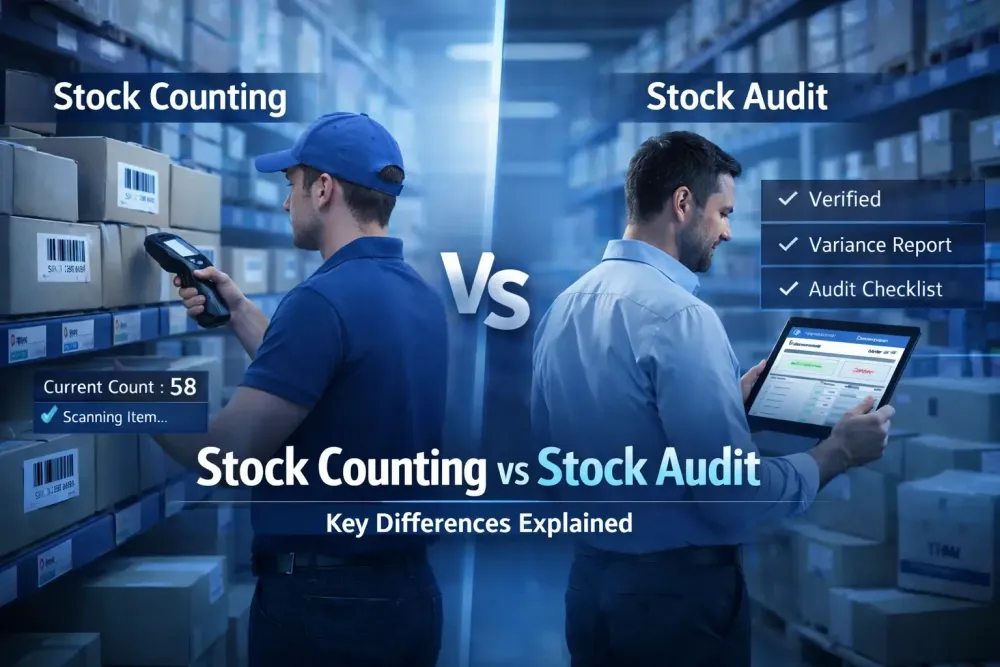
Quick answer: Stock counting is the physical process of verifying how many units of an item you have on hand right now. A stock audit is a broader review of your entire inventory process how items are counted, recorded, and moved to confirm the numbers can be trusted. Counting tells you what you have. Auditing tells you whether your process for tracking it is reliable.
If you've ever sat in a stock review meeting and heard "we counted the stock last week" right after "we need to audit the warehouse," you've probably wondered if those are the same thing. They're not and businesses that treat them as interchangeable are usually the ones with the messiest stock reports.
What Is Stock Counting?
Stock counting is the physical act of counting inventory items and matching that number against what your system records. It answers one question: how much do we actually have, right now, in this location?
Common counting methods:
- Periodic counting — counting everything, usually once a quarter or year, often pausing operations to do it
- Cycle counting — counting a small portion of stock on a rotating schedule (daily or weekly), so the whole warehouse gets covered without a full shutdown
- Perpetual counting — continuous counting as items move, typically only possible with barcode or RFID-based systems tracking every transaction Counting is tactical and repetitive. On its own, it tells you that your numbers are off — not why.
What Is a Stock Audit?
A stock audit is a structured review of your entire inventory process — not just the quantity on the shelf, but whether the process producing that number can be trusted. An audit asks:
- Are our counting methods actually reliable?
- Where are discrepancies happening, and why?
- Is there a pattern — theft, damage, miscounting, receiving errors?
- Are we compliant with internal controls or regulatory requirements?
- Can we trust these numbers in financial statements? An audit uses counting as one input, but also reviews documentation, approval workflows, movement logs, and variance history over time. It's less frequent than counting but far more thorough.
Stock Counting vs Stock Audit: Comparison Table
| Stock Counting | Stock Audit | |
|---|---|---|
| Purpose | Verify physical quantity | Verify process integrity and accuracy |
| Frequency | Daily, weekly, or quarterly | Quarterly, annually, or triggered by an issue |
| Scope | Specific items or locations | Entire inventory process, end-to-end |
| Who's involved | Warehouse staff, stock clerks | Auditors, finance team, senior warehouse managers |
| Tools used | Barcode scanners, count sheets, cycle count apps | Audit trail reports, variance history, movement logs |
| Output | Updated stock quantity | Findings report, root-cause analysis, corrective actions |
| Catches | "We're short by 12 units" | "We're short every month on the same 3 SKUs, and it traces back to receiving, not dispatch" |
The last row is the key distinction: counting tells you what is wrong. Auditing tells you where and why the only way to actually fix it, rather than just re-count and hope it corrects itself.
Real Example: Why Counting Alone Wasn't Enough
Ravi Kumar, who manages parts inventory at VMC Royal Enfield, ran consistent weekly cycle counts across his warehouse. The counts kept coming back close enough to expected numbers that nothing raised a flag on a week-to-week basis.
It was only when a broader audit was run, pulling movement history and cross-checking it against receiving records, that a pattern emerged: a specific category of fast-moving parts had a small, repeated variance every single cycle. Not big enough to catch attention in any one week, but consistent enough to add up to a real loss over several months.
The counting process wasn't broken, it was doing exactly what counting is designed to do: confirm quantity at a point in time. What it couldn't do was surface a pattern across time. That's audit territory, and it's the gap most growing businesses fall into: they count regularly, assume that's equivalent to auditing, and only discover otherwise when a larger discrepancy forces a deeper look.
Industry context: retailers and distributors that rely on periodic counting alone typically carry inventory record inaccuracy in the 10-30% range at the SKU level, according to widely cited retail operations research, a gap that routine counting rarely surfaces on its own because it only checks quantity, not the process behind it.
Quick gut check: if someone asked you right now, "what's your stock variance trend over the last six months, broken down by cause?" could you answer in under five minutes? If not, you're counting, but you're not auditing.
Still counting on spreadsheets to catch this?
Most businesses don't find out they have a variance pattern until it's already cost them a few lakhs. Stockount tracks every cycle count against your audit trail automatically, no manual reconciliation, no waiting for year-end to spot the leak.
Takes under 2 minutes to set up your first count.
How Stockount Handles Both in One Workflow
Most stock counting apps stop at counting: scan, tally, update quantity, done. If you want the audit layer, variance trends, root-cause tagging, movement history — you're usually stuck exporting data into spreadsheets and building that analysis by hand.
Stockount closes that gap. Every cycle count automatically feeds into an audit trail that tracks variance patterns over time, flags recurring discrepancies by SKU or location, and surfaces movement history you can investigate without pulling three separate reports together. Instead of "count now, audit later, maybe," it's count and audit as one continuous process , the only way to catch a slow-leak discrepancy like the one Ravi's team eventually traced.
5 Signs You Need Both, Not Just One
- Your counts are "accurate," but year-end numbers never match — counting is fine, but nothing upstream is being verified.
- The same SKUs show small variances every cycle — small enough to ignore individually, big enough to matter over a year.
- You've never traced a variance to a root cause — receiving error, damage, theft, miscount — if you don't know which, you're only counting.
- Multiple people touch inventory with no audit trail — more hands, more room for untracked discrepancies.
- You're preparing for a compliance review, insurance claim, or investor due diligence these require audit-grade documentation, not a count sheet. If two or more of these sound familiar, counting alone won't give you the visibility you need.
Frequently Asked Questions
Is a stock audit the same as stock counting? No. Stock counting physically verifies quantity on hand. A stock audit reviews the entire inventory process — how counts are performed, how discrepancies are tracked, and whether the records can be trusted for financial or compliance purposes.
What is the difference between cycle counting and a stock audit? Cycle counting is a rotating physical count of a subset of inventory, done frequently (daily or weekly). A stock audit is a periodic, comprehensive review that examines counting accuracy, variance patterns, and process controls across the whole operation, not just a subset.
How often should a business conduct a stock audit? Most businesses run a full audit annually or quarterly, with cycle counts happening far more often in between. Businesses with high-value or fast-moving inventory typically audit more frequently, or trigger an audit whenever variance patterns appear.
Can a small business skip audits and rely on counting alone? It's possible, but risky. Counting alone catches quantity errors at a single point in time and won't surface a slow, recurring discrepancy building up over months. Even a lightweight quarterly audit is usually enough to catch patterns before they become significant losses.
What triggers an unscheduled stock audit? Common triggers include a large unexplained variance, suspected theft or fraud, a change in warehouse management, preparation for financial statements, or a compliance or insurance requirement.
Do I need separate software for stock counting and inventory auditing? Not necessarily. Platforms like Stockount combine both functions cycle counting feeds directly into audit trail and variance reporting, so data doesn't need to be manually stitched together from two different systems.
What is inventory record inaccuracy and how does auditing help? Inventory record inaccuracy is the gap between what your system says you have and what you physically have. Auditing helps by identifying why that gap exists the root cause rather than just restating the quantity difference, which is all a routine count can do.
See It on Your Own Stock Data
Reading about the difference is one thing — seeing where your variances are actually coming from is another. Book a 20-minute walkthrough and we'll show you how Stockount's audit trail would flag discrepancies in your current setup, using your own SKUs and count history if you have them ready.