Stock Variance Tracking: How to Reduce Variance Fast
| By Stockount
Introduction
A warehouse manager closes the books at month-end and finds 340 units of a fast-moving SKU missing from the system. No one stole anything. No fire happened. The stock simply "disappeared" over weeks of small, unnoticed errors, a miscount here, a wrong bin transfer there, an unscanned return sitting in a corner.
This is stock variance, and it rarely announces itself loudly. It builds quietly, order after order, until it shows up as a write-off on the balance sheet or a stockout in front of a customer.
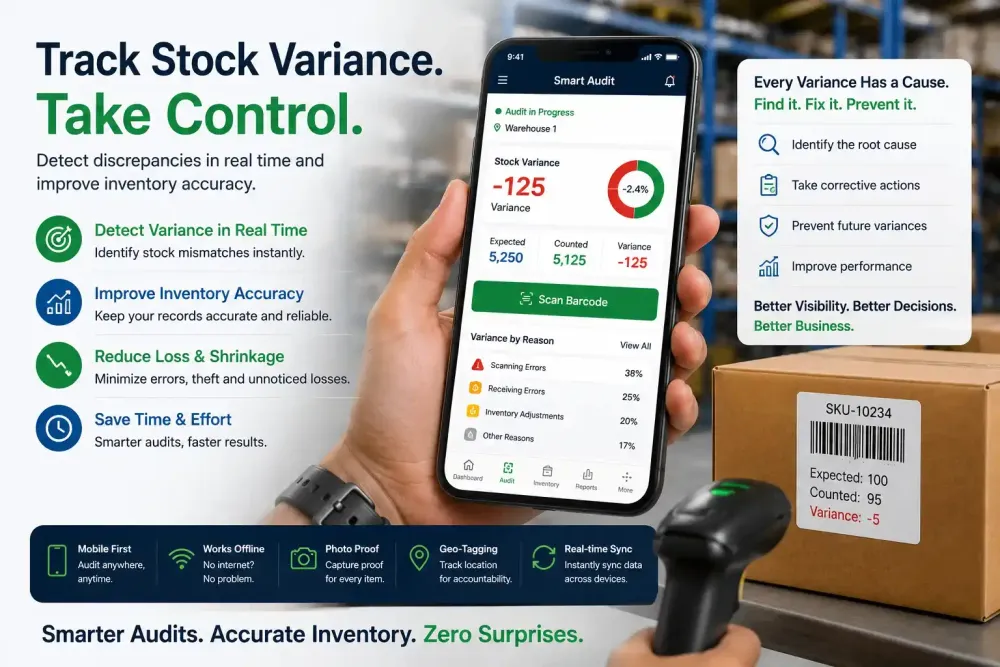
Stock variance tracking is how businesses catch this problem early instead of discovering it during a painful annual audit. Done right, it turns inventory accuracy from a guessing game into a measurable, controllable process.
In this guide, you'll learn what stock variance actually is, why it happens, the hidden costs it creates, and 10 proven ways to reduce it, along with industry-specific guidance and the KPIs that matter most.
What is Stock Variance?
Stock variance is the difference between the inventory quantity recorded in your system and the actual physical stock counted in your warehouse or store.
Formula
Stock Variance = System Stock Quantity − Physical Stock Quantity
Example
If your inventory system shows 1,000 units of a product but a physical count finds only 960 units, your stock variance is 40 units, or a 4% variance rate.
Business Impact
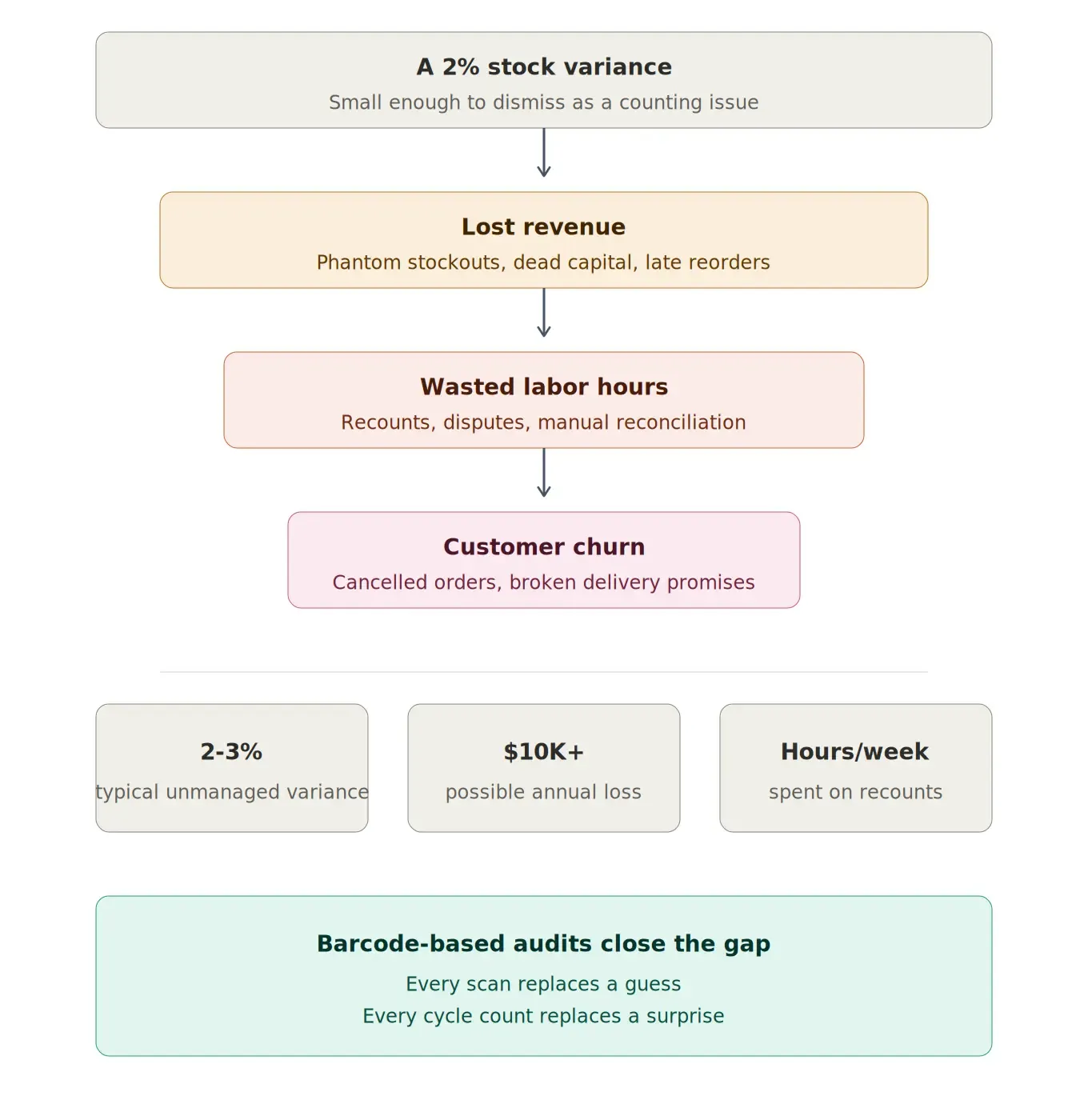
Even small variance percentages compound across thousands of SKUs. A 2-3% variance rate across a mid-sized warehouse can translate into tens of thousands of dollars in unexplained losses every year, along with inaccurate reorder triggers and unreliable financial reporting.
Common Causes of Stock Variance
Stock variance is rarely caused by one single issue. It's usually a mix of small, repeated process gaps:
- Manual counting errors — miscounted cartons, mistyped quantities, or skipped rows during a physical inventory audit.
- Receiving errors — goods received but not logged accurately against the purchase order.
- Shipping mistakes — wrong quantities picked or packed against an order.
- Warehouse transfers — stock moved between bins or locations without an updated record.
- Returns — returned items not added back into available stock correctly.
- Inventory shrinkage — theft, fraud, or administrative errors reducing recorded stock.
- Damaged products — damaged units not written off or removed from active inventory.
- Human error — fatigue, rushed counts, or unclear SOPs during stock taking.
- Poor inventory visibility — no real-time view across multiple locations or channels.
- ERP sync issues — delays or failures syncing data between your WMS, ERP, and point-of-sale systems.
Most teams stop at "we have a counting problem." But identifying the symptom isn't the same as fixing the cause. If you want a structured way to dig deeper into why variance keeps recurring at specific SKUs or locations, our guide on How to Find the Root Cause of Inventory Variance walks through a step-by-step investigation framework.
The Hidden Cost of Stock Variance
Stock variance doesn't just create a number on a spreadsheet — it ripples across your entire operation.
| Problem | Operational Impact | Financial Impact | Customer Impact |
|---|---|---|---|
| Inaccurate stock counts | Wrong reorder points, excess or stockouts | Tied-up capital or lost sales | Delayed or cancelled orders |
| Untracked shrinkage | Repeated losses go unnoticed | Direct write-offs reduce margin | Price increases to offset losses |
| Manual audit delays | Staff hours spent on slow recounts | Higher labor cost per audit | Slower order fulfillment |
| Poor multi-location visibility | Inventory imbalance across sites | Emergency freight costs | Inconsistent stock availability |
| Inaccurate financial records | Audit and compliance risk | Penalties, restatement costs | Indirect — erodes business trust |
10 Proven Ways to Reduce Stock Variance
1. Switch from Manual Counts to Barcode-Based Audits
A team counting 2,000 SKUs by hand isn't just slow, every handwritten or manually typed quantity is a chance for a "120" to become "12" or "1200." A mid-sized pharmacy distributor we'd recognize the pattern from typically sees count errors drop sharply within the first one or two cycles after switching from paper sheets to barcode scanning, simply because the scan removes the transcription step entirely.
The catch is that barcode scanning only pays off if every unit gets scanned. Teams under time pressure sometimes scan a sample and extrapolate the rest of a carton's contents, which reintroduces the exact guesswork the scanner was supposed to eliminate.
2. Implement Regular Cycle Counting
Annual physical inventories tell you what went wrong sometime in the past 12 months. Cycle counting tells you what's going wrong this week. A retailer that counts its top 20% of SKUs (by revenue or velocity) weekly, instead of waiting for a year-end count, catches a developing discrepancy while it's still a 2-unit gap, not after it's grown into a 40-unit write-off.
The mistake worth avoiding here is treating every SKU as equally important. Counting a slow-moving, low-value item with the same frequency as your best-seller wastes labor hours that should be going toward the items where variance actually costs you money.
3. Standardize Receiving Procedures
A surprising share of "warehouse" variance never actually started in the warehouse, it started at the dock. A pallet gets received, a staff member confirms "looks about right," and the stock is moved to shelves before anyone matches the actual count against the purchase order. By the time a discrepancy surfaces weeks later, there's no way to tell if it was a supplier shortfall, a miscount, or theft in transit.
Requiring a second person to verify quantities on shipments above a set value, and logging the count before put-away, not after — closes this gap at the point where it's cheapest to catch.
4. Tighten Returns Processing
Returns are where inventory data quietly falls apart. An e-commerce seller can have dozens of returned units sitting in an "unprocessed" bin for days, fully present in the building but invisible to the system, meaning the same item gets reported as out of stock to a customer who could have bought it that afternoon.
Setting a strict window (24-48 hours, for example) to inspect, log, and restock every return keeps this from becoming a backlog that nobody owns. The common failure mode is treating returns as the lowest-priority task on the floor, which is exactly backwards, unprocessed returns are stock you've already paid for, sitting idle.
5. Use Role-Based Access and Approvals
When every warehouse staff member can adjust stock quantities directly, variance becomes nearly impossible to investigate after the fact — there's no way to tell whether an adjustment was a genuine correction or an accidental keystroke. Limiting who can approve write-offs above a certain quantity, and requiring a reason logged against every adjustment, turns "the system shows a different number now" into "Raj approved a 12-unit write-off on March 4th for damaged stock in bay 3."
That audit trail doesn't just catch errors faster — it changes behavior, because people are more careful when they know an adjustment has their name attached to it.
6. Improve Bin and Location Accuracy
Stock that's physically present but logged in the wrong bin behaves exactly like stock that's missing — a picker checks the location the system points to, finds nothing, and reports a stockout. Meanwhile the actual units sit one aisle over, invisible to anyone not specifically looking for them.
This is worth treating as its own audit category rather than folding it into general stock counts. A warehouse can be 98% accurate on total quantities and still lose significant picking time to bin-location errors that a quantity-only audit would never catch.
7. Use Photo Validation During Audits
A written note saying "5 units damaged, written off" is a claim. A photo of the damaged units is evidence. When a distributor requires photo capture for any flagged discrepancy — damaged goods, mismatched serial numbers, unexpected shortfalls, the next person reviewing that adjustment doesn't need to recount or take it on faith. They can see exactly what was found.
This matters most for high-value or frequently disputed items, where a typed explanation alone tends to trigger a second physical recount anyway, doubling the labor cost of resolving a single discrepancy.
8. Sync Inventory Across Channels in Real Time
A brand selling on its own site plus two marketplaces is really running three separate "available stock" numbers unless those channels are connected. During a flash sale, even a 20-30 minute sync delay can mean the same units get sold twice, once on each channel, and the business finds out only when a cancellation email has to go out to a paying customer.
End-of-day batch syncing might be fine for slow-moving inventory, but for anything fast-moving or promotion-driven, the gap between sale and sync is exactly where phantom stock gets created.
9. Conduct Offline Inventory Audits for Remote Sites
Plenty of audit software simply assumes a stable internet connection, which quietly excludes remote warehouses, rural distribution points, or basement storage areas with poor signal from the same discipline applied everywhere else. Over time, those locations become the ones nobody can explain when a company-wide variance report comes back ugly.
Software that captures counts offline and syncs once connectivity returns means a warehouse in a low-connectivity zone gets audited on the same schedule as headquarters, not skipped because of where it happens to sit.
10. Track Variance KPIs Continuously
A manufacturer that reviews variance percentage weekly, rather than discovering it during an annual audit, can usually point to exactly which SKU or shift started drifting and when. A business that only checks once a year is, by definition, finding out about a problem that's already 12 months old.
The KPI itself doesn't have to be complicated, variance % by location, by SKU category, or by shift is usually enough to surface a pattern early. What matters is that someone is actually looking at it on a fixed schedule, not just generating the report and filing it away.
Quick gut-check: if you can't tell me your last cycle count's accuracy % off the top of your head, that's not a knowledge gap, that's a visibility gap. See what your stock actually looks like right now →
Why Barcode Inventory Tracking Works
Barcode inventory tracking reduces stock variance by removing manual data entry from the counting process, ensuring every unit scanned is recorded accurately and instantly.
| Manual Process | Barcode Process |
|---|---|
| Handwritten or typed counts | Scanned, system-recorded counts |
| Prone to transcription errors | Near-zero entry errors |
| Slow, labor-intensive | Faster per-unit count speed |
| Delayed data updates | Real-time inventory updates |
| Difficult to audit later | Full digital audit trail |
Benefits: Faster audits, fewer disputes, and accurate real-time stock levels.
ROI: Businesses typically recover the cost of barcode-based audit software within a few audit cycles through reduced shrinkage and labor savings.
Cycle Counting vs Physical Inventory
| Factor | Cycle Counting | Physical Inventory |
|---|---|---|
| Pros | Frequent, low disruption, catches errors early | Comprehensive, full system reset |
| Cons | Requires consistent scheduling | Disruptive, labor-intensive, infrequent |
| Best Use Case | Ongoing accuracy maintenance | Year-end financial reconciliation |
Most well-run operations use both: cycle counting for continuous accuracy and a full physical inventory audit for annual reconciliation.
Industry Solutions
Stock variance doesn't behave the same way in a pharmacy as it does in an auto parts warehouse. The SKU count, the unit value, and the point where things actually go wrong are different in every industry, so the fix can't be a copy-paste process either.
Retail
A 12-store apparel chain doesn't lose inventory in one dramatic event. It loses it in small, repeated ways: a cashier overrides a price and forgets to log a damaged return, a store-to-store transfer gets logged at the sending location but never confirmed at the receiving one, and the POS system shows stock that physically left the shelf weeks ago through unrecorded shrinkage.
The real issue is rarely the count itself — it's that each store operates as its own silo. Head office sees aggregated numbers but can't tell which of the 12 stores is driving the variance until the damage is already done.
What actually works: Weekly cycle counts on the top 20% of SKUs by revenue, with variance reported per store, not just company-wide. Once a manager can see "Store 7 is off by 6% on footwear three weeks running," the conversation changes from "let's recount everything" to "let's find out what's happening at Store 7."
Manufacturing
Manufacturing variance usually hides in the gap between raw materials and finished goods. A production line consumes 480 units of a component to build 100 finished units, but the BOM (bill of materials) assumed only 450 would be needed. That 30-unit gap — scrap, rework, or operator overuse — never gets logged as a separate line item. It just shows up as "missing" raw material at the next audit.
What actually works: Auditing at each production checkpoint, not just at the start and end of the line. If a plant tracks consumption stage-by-stage (raw material issue → WIP → finished goods), the exact stage where loss occurs becomes visible instead of being averaged out across the whole process.
Warehousing
In a large distribution center, variance is often a location problem disguised as a counting problem. A pallet gets put away in bin C-14 instead of C-41 — a single transposed digit — and from that point on, the system insists the SKU is out of stock in the correct bin while 40 units sit one aisle over, untouched, for weeks.
What actually works: Treating bin accuracy as its own metric, separate from stock accuracy. A warehouse can have 98% inventory accuracy and still bleed productivity if pickers can't find what the system says is there. Routine bin-location audits, not just SKU-quantity audits, catch this.
E-commerce
A brand selling on its own site plus two marketplaces faces a specific failure mode: a sync delay of even 20–30 minutes during a flash sale can mean the same 50 units get sold twice across channels. By the time the system reconciles, 15 customers have a confirmed order for stock that doesn't exist.
What actually works: Treating "available to sell" as a single, centrally-updated number rather than letting each channel hold its own cached count. Variance here isn't really discovered in a count, it's discovered in a cancellation email to a customer, which makes it far more expensive than a warehouse-only discrepancy.
FMCG
FMCG businesses move volume fast enough that a once-a-month count is already outdated by the time it's reviewed. A beverage distributor might turn over an entire SKU's stock in 10 days; a variance that started small on day one can compound through several replenishment cycles before anyone notices.
What actually works: Prioritizing count frequency by velocity, not value. A low-cost, high-velocity SKU often needs more frequent counting than an expensive, slow-moving one, because errors compound faster relative to how often the stock turns over.
Pharmaceutical
This is one of the few industries where variance isn't just a financial problem, it's a compliance one. A mismatch between system and physical stock on a controlled substance, even a small one, can trigger regulatory scrutiny. Batch and expiry data adds another layer: a count can be "accurate" on total units while still being wrong on which batch those units belong to.
What actually works: Batch-level audit trails with mandatory approval steps for any adjustment, so every correction has a name, a reason, and a timestamp attached, not just a revised number.
Automotive
Auto parts inventory is notoriously hard to count visually, a bin of similar-looking brake pads or sensors for different vehicle models can look identical at a glance. A picker grabs the wrong but visually similar part, the order ships, and the inventory system now thinks two different SKUs are wrong by one unit each.
What actually works: Barcode or part-number scanning at the point of picking, not just at receiving. Photo validation on high-value parts during cycle counts also helps catch mismatches before they reach a customer.
Electronics
Serialized inventory means every unit theoretically has its own identity, but in practice, manual serial number entry is slow enough that staff under time pressure sometimes batch-log units instead of scanning each one. One mistyped serial number doesn't just create a quantity variance, it creates a tracking gap that can affect warranty and returns processing later.
What actually works: Scan-only policies for serialized stock, with no manual entry fallback except for documented exceptions. The discipline matters more than the technology here.
Wholesale
Wholesale variance often starts at the dock with pallet-level receiving. A shipment manifest says 40 pallets; the team confirms 40 pallets arrived but doesn't verify unit counts inside each one. If two pallets were under-packed by the supplier, that shortfall doesn't surface until the stock is picked weeks later — by which point it looks like an internal warehouse error rather than a receiving issue.
What actually works: Spot-checking unit counts inside a sample of pallets at receiving, not just confirming pallet counts. It adds a few minutes per shipment but catches supplier-side errors before they're misattributed internally.
Logistics & 3PL
A 3PL managing inventory for multiple clients faces a multiplier effect: each client may have its own SKU naming conventions, count cadences, and tolerance for variance. Without a standardized internal process, the 3PL ends up running five different inventory disciplines under one roof — and inconsistency itself becomes a source of error.
What actually works: One standardized audit protocol applied across all client accounts, with client-specific reporting layered on top rather than client-specific processes underneath. This keeps the operational discipline consistent even as reporting requirements vary.
KPIs Every Warehouse Should Track
- Inventory Accuracy % — how closely system stock matches physical stock.
- Variance % — the percentage gap between recorded and counted stock.
- Shrinkage % — stock loss due to theft, damage, or error.
- Inventory Turnover — how often stock is sold and replaced over a period.
- Cycle Count Accuracy — accuracy rate of scheduled cycle counts.
- Audit Completion Time — time taken to complete a full inventory audit.
15-Point Stock Variance Reduction Checklist
- Schedule regular cycle counts by SKU priority
- Use barcode scanning for every count
- Standardize receiving verification steps
- Process returns within a fixed time window
- Set role-based approval for stock adjustments
- Audit bin and location accuracy regularly
- Require photo validation for flagged discrepancies
- Sync inventory across all sales channels in real time
- Enable offline audit capability for remote sites
- Track variance % on a weekly dashboard
- Investigate root causes for recurring discrepancies
- Set acceptable variance thresholds per SKU category
- Train staff on consistent counting SOPs
- Maintain a digital audit trail for every adjustment
- Review KPIs monthly with operations leadership
Why Businesses Choose Stockount
Reducing stock variance consistently requires the right process and the right tools to support it. Stockount supports this with real-time stock variance tracking, barcode scanning, offline inventory audits, and inventory reconciliation built for multi-location operations.
Teams use Stockount's variance dashboards, audit reports, and photo validation features to flag discrepancies as they happen rather than discovering them months later. Role-based approval keeps adjustments accountable, and export reports make it easy to share audit results with finance or leadership teams.
It's not about replacing your process, it's about giving your existing inventory team better visibility and fewer manual steps.
FAQs
1. What is stock variance tracking? Stock variance tracking is the ongoing process of comparing system inventory records against physical stock counts to identify and correct discrepancies.
2. How do you calculate stock variance? Subtract the physical stock count from the system-recorded stock quantity to get the variance amount, then divide by system stock for a variance percentage.
3. What is an acceptable inventory variance percentage? Most well-managed operations aim for under 1-2% variance, though acceptable thresholds vary by industry and SKU value.
4. What causes stock variance in a warehouse? Common causes include manual counting errors, receiving and shipping mistakes, untracked returns, shrinkage, and poor system synchronization.
5. How often should cycle counts be done? High-value or fast-moving SKUs are typically counted weekly or biweekly, while lower-priority items can be counted monthly or quarterly.
6. What's the difference between cycle counting and physical inventory? Cycle counting involves frequent, partial counts throughout the year, while physical inventory is a full, comprehensive count usually done annually.
7. How does barcode scanning reduce inventory errors? Barcode scanning removes manual data entry, ensuring each scanned unit is recorded accurately and instantly in the system.
8. Can stock variance be eliminated completely? Variance can be significantly reduced but rarely eliminated entirely; the goal is to keep it within a controlled, low threshold.
9. What industries struggle most with stock variance? Retail, FMCG, pharmaceutical, and e-commerce businesses often face higher variance due to high SKU velocity and multi-location complexity.
10. How does inventory audit software help reduce variance? Inventory audit software standardizes counting, automates data capture, flags discrepancies in real time, and creates an audit trail for accountability.
Conclusion
Stock variance is one of those problems that's easy to ignore until it shows up as a real financial loss. The good news is that it's almost entirely controllable with consistent processes, accurate receiving, regular cycle counts, barcode-based audits, and clear accountability for adjustments.
Start small: pick your highest-value SKUs, set up a regular counting cadence, and track your variance percentage every week instead of once a year.
If a specific SKU or location keeps showing up in your variance reports, it's worth digging deeper. Our guide on How to Find the Root Cause of Inventory Variance breaks down exactly how to investigate and fix recurring discrepancies.
One last thought: most teams don't fix variance because they finally found "the" cause. They fix it because someone finally watched a real count happen, end to end, and asked "wait, why are we still doing it like this?" If you want that moment without waiting for your next painful audit, put 20 minutes on our calendar and we'll walk through your actual numbers — not a generic product tour.