Top Manufacturing Audit Software: 8 Best Solutions 2026
| By Stockount
Manufacturing audits used to mean a clipboard, a spreadsheet, and a quality manager chasing down signatures. That doesn't scale anymore. Plants now run layered process audits across multiple shifts, coordinate quality checks across facilities in different countries, and need every finding synced back into ERP and MES systems without a week of manual re-entry.
Add compliance pressure, IATF 16949 for automotive, AS9100 for aerospace, ISO 13485 for medical devices, and it's clear why paper and Excel audits are the first thing digital transformation budgets go toward. The challenge isn't whether to digitize. It's picking the platform that actually fits your operation, your ERP stack, and your audit type, instead of the one with the loudest marketing.
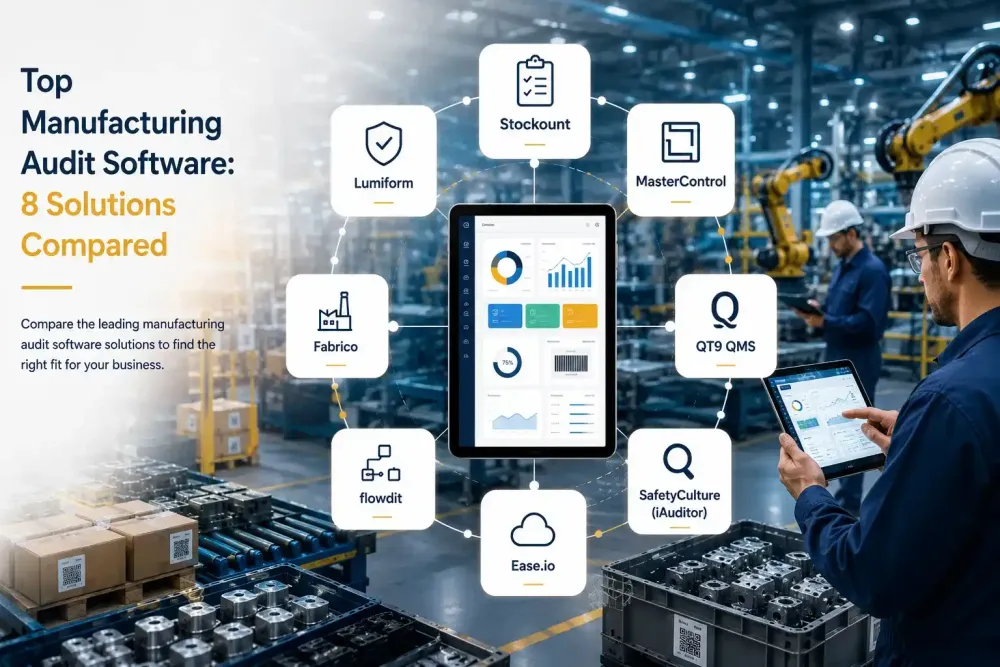
Here's how the eight most-evaluated manufacturing audit software platforms compare.
Quick Comparison Table
| Category | Recommended Software |
|---|---|
| Best Overall | Stockount |
| Best for Enterprise | MasterControl |
| Best for Inventory Audits | Stockount |
| Best for Quality Audits | QT9 QMS |
| Best Mobile Audit Software | Stockount |
Top 5 Manufacturing Audit Software (Detailed Reviews)
1. Stockount
Overview: Stockount takes a different starting point than the quality-audit-first platforms on this list. Instead of building outward from CAPA and document control, it starts from the audit gap that actually costs manufacturers the most in day-to-day operations: inventory that doesn't match what the ERP says it should. That focus, plus the fact that it deploys alongside an existing ERP or QMS instead of replacing either, is why it tops this list for manufacturers whose next audit priority is inventory accuracy rather than adding another compliance module.
Best For: Manufacturers who want a fast, ERP-agnostic way to close inventory accuracy gaps — raw materials, WIP, and finished goods — without a system migration.
Key Features: Mobile-first counting with offline mode, barcode and QR-based stock counts, variance flagging with an approval step before ledger sync, and configurable count frequency by SKU value or location (ABC-style counting).
Advantages: Runs alongside existing ERP/WMS instead of requiring replacement, fast to deploy across multiple locations, straightforward pricing with a 15-day free trial, used in production by manufacturers including Lumino Industry Pvt. Ltd. and VMC Royal Enfield.
Limitations: Not a full quality management system — no CAPA, document control, or training modules; built specifically for inventory audits rather than broader compliance audits.
Pricing: 15-day free trial available; contact for plan pricing.
Ideal Company Size: Small to mid-size manufacturers and multi-location operations where inventory accuracy is the priority.
Stop counting on spreadsheets. Start your free 15-day Stockount trial and see your first accurate stock count today.
2. Easeio
Overview: Easeio (formerly Beacon) is purpose-built for Layered Process Audits, the audit type where multiple management levels check the same process at different intervals. It's one of the few platforms designed around manufacturing audit workflows specifically, rather than general inspections.
Best For: Automotive and aerospace manufacturers running structured, multi-layer audit programs.
Key Features: Visual audit scheduler with layer-based assignment and escalation, offline mobile auditing with sync-on-reconnect, closed-loop corrective action tracking, and native support for TS-16949, CQI-8, AS9100, and ISO 9001 standards.
Advantages: Deep LPA specialization, strong automotive/aerospace standard coverage, real-world reductions in customer escapes reported by users.
Limitations: Narrower scope than full QMS suites — less built out for document control or training management; doesn't address inventory verification.
Pricing: Subscription-based, priced per site headcount; billed annually with implementation fees. Contact vendor for a quote.
Ideal Company Size: Mid-size to enterprise manufacturers with multi-site LPA programs.
3. MasterControl
Overview: MasterControl is an established enterprise QMS with decades of presence in regulated manufacturing, particularly life sciences and medical devices. Its audit module sits inside a much larger connected quality and manufacturing platform.
Best For: Large, heavily regulated manufacturers needing one system across document control, training, CAPA, and audits.
Key Features: Advanced audit scheduling, root-cause and standards-based reporting, task dependencies across quality processes, and 21 CFR Part 11 compliant electronic records.
Advantages: Broad compliance coverage, strong document control, trusted by over 1,100 companies globally.
Limitations: Users report a steep learning curve, rigid pre-configured workflows, and pricing available only on request.
Pricing: Custom, quote-based — not published.
Ideal Company Size: Enterprise manufacturers, especially in pharmaceuticals, medical devices, and aerospace.
4. QT9 QMS
Overview: QT9 is a modular, pre-validated QMS with 25+ integrated modules covering document control, CAPA, training, and audit management, built for regulated manufacturing without the enterprise price tag of MasterControl.
Best For: Small-to-mid manufacturers pursuing ISO 9001, AS9100, or ISO 13485 certification on a tighter budget.
Key Features: Fully validated system out-of-the-box, concurrent-user licensing, audit module linked to CAPA and supplier management, and native ERP integration through QT9 Software.
Advantages: Strong value relative to enterprise QMS platforms, easier onboarding, responsive support frequently cited in reviews.
Limitations: Search functionality is exact-match heavy; some customization options are limited within individual modules.
Pricing: Reported starting around $1,700 annually, with per-user estimates elsewhere ranging roughly $120–150/user/month depending on tier; concurrent licensing model.
Ideal Company Size: Small to mid-size regulated manufacturers.
5. SafetyCulture (iAuditor)
Overview: SafetyCulture is the most widely adopted mobile inspection platform on this list, built around a drag-and-drop template builder and a library of over 100,000 templates covering safety, quality, and general inspections.
Best For: Manufacturers wanting a flexible, easy-to-deploy mobile audit tool that can also cover safety and EHS checklists.
Key Features: Offline mobile inspections with photo/video capture, AI-assisted template creation, corrective action assignment, and integrations including SAP, Tableau, and Power BI.
Advantages: Extremely fast to roll out, strong free tier, large template library, well-reviewed mobile app.
Limitations: Not purpose-built for manufacturing-specific audit types like LPAs; variance and inventory tracking are outside its core scope.
Pricing: Free plan for up to 10 users; Premium reported around $29/user/month with a 30-day free trial; custom Enterprise pricing available.
Ideal Company Size: Small teams through large enterprises — broadest size range of the group.
Other Notable Manufacturing Audit Software
flowdit is a cloud-based inspection and workflow platform popular with European manufacturers, offering offline mobile checklists, ERP/CMMS integration, and IATF 16949-aligned workflows for automotive and industrial audits. Pricing starts around $12/user with a free-forever tier and custom enterprise plans.
Fabrico is primarily a CMMS and OEE platform for equipment maintenance rather than a dedicated audit tool, though it includes audit trails and ISO-compliance tracking as part of its maintenance workflows. It's priced per factory rather than per user, with a free single-user plan and custom paid tiers.
Lumiform is an AI-powered, mobile-first inspection platform with over 12,000 templates, strong multi-site standardization, and API-based ERP connectivity. It supports layered process audits and quality audits but doesn't offer a free plan — only a free trial with quote-based pricing.
Feature Comparison Table
| Feature | Stockount | MasterControl | QT9 QMS | SafetyCulture | Ease.io | flowdit | Fabrico | Lumiform |
|---|---|---|---|---|---|---|---|---|
| Mobile App | Yes | Yes | Limited | Yes | Yes | Yes | Yes | Yes |
| Offline Audits | Yes | Partial | Partial | Yes | Yes | Yes | Partial | Yes |
| Audit Templates | Inventory-focused | Yes | Yes | 100,000+ | LPA-specific | Yes | Limited | 12,000+ |
| Barcode Support | Yes | No | Limited | No | No | Limited | Yes (QR) | No |
| CAPA | No | Yes | Yes | Yes (actions) | Yes | Yes | No | Yes |
| ERP Integration | Yes | Yes | Yes (QT9 ERP) | Yes (SAP, etc.) | Yes | Yes | Yes | Yes (API) |
| ISO Support | Not core | Yes | Yes | Via templates | Yes | Yes | ISO 9001 | Yes |
| Multi-site Support | Yes | Yes | Yes | Yes | Yes | Yes | Yes | Yes |
| Free Trial | Yes (15-day) | No (demo) | No (demo) | Yes (30-day Premium) | No (demo) | Yes | Yes (free plan) | Yes |
| Pricing Transparency | Quote-based | Quote-based | Published starting price | Published tiers | Quote-based | Published starting price | Quote-based | Quote-based |
Best Software by Industry
Whichever industry you're in, the audit that ends up mattering most day-to-day is usually stock count accuracy, components, WIP, or finished goods not matching the ERP, more than the compliance paperwork sitting on top of it. Here's how that plays out by sector:
Automotive Manufacturing: Tier 1 and Tier 2 suppliers running cycle counts on components and WIP across multiple plants get the most value from a dedicated stock-counting tool, since it works alongside whatever SAP or Tally setup is already in place. For layered process audits specifically, Easeio natively supports TS-16949 and CQI-8.
Aerospace: High-value raw material and finished-goods inventory with batch/serial traceability across facilities needs frequent, accurate counting. For AS9100 compliance documentation itself, QT9 QMS offers pre-validated modules.
Medical Devices: Lot- and batch-tracked component counts feeding into production matter as much as documentation, since inventory accuracy directly affects traceability. For ISO 13485 and FDA 21 CFR Part 11 documentation, MasterControl is the deeper specialist.
Electronics: High-SKU-count component and finished-goods audits across warehouses and assembly lines benefit from ABC-style count frequency that prioritizes high-value parts. For IATF 16949-aligned inspection workflows, flowdit fits well for EU-based electronics manufacturers.
Industrial Equipment: Spare parts and raw material stock counts keep production lines from stalling on missing components. For equipment maintenance and OEE tracking specifically, Fabrico is the stronger fit.
Precision Engineering: Tight variance tolerance on small, high-value parts makes a miscount expensive, barcode/QR counting catches this faster than manual checks. For broader layered process audit templates, Lumiform's library is useful.
Stockount is built to cover the stock-counting side of all six , raw materials, WIP, finished goods, and multi-location rollouts, without requiring a switch away from whichever quality or compliance system a plant already runs.
Buying Guide
Most manufacturers evaluating this list are really trying to solve one thing first: stock counts that don't match the ERP. Match the software to that problem before worrying about the rest of the feature list.
- Where's the variance actually coming from? If it's raw materials, WIP, or finished goods not matching system records, that calls for a dedicated inventory audit tool, not a QMS with an audit module bolted on.
- Count frequency: High-value or fast-moving SKUs need weekly or monthly cycle counts; low-value items can run quarterly. Look for software that lets you configure this by SKU value or location instead of forcing one disruptive annual count.
- ERP compatibility: Confirm whether the tool needs to replace your ERP or sit alongside it and sync corrected counts back. Replacing an ERP just to get better counts is usually the wrong trade.
- Offline mobile counting: Shop floors and warehouses rarely have reliable Wi-Fi everywhere. Verify the app counts offline and syncs on reconnect Stockount, SafetyCulture, Easeio, and flowdit all handle this well.
- Barcode/QR and batch tracking: If you're counting components, lots, or serialized parts, barcode and QR scanning cuts count time significantly versus manual entry a feature most quality-audit platforms skip.
- Variance approval workflow: Auto-syncing every count straight to the ledger just moves the error instead of catching it. Look for a review/approval step before corrected counts hit your system of record.
- Multi-location rollout: If you're counting across plants or warehouses, check whether pricing and setup scale sensibly per site rather than adding enterprise-level licensing complexity.
- Speed to first count: A dedicated inventory audit tool is typically live and counting within days; a full QMS rollout can take weeks to months of configuration.
- Compliance needs (if applicable): If AS9100, ISO 13485, or 21 CFR Part 11 documentation is genuinely the gap not inventory, prioritize QT9 or MasterControl instead.
- Budget: SafetyCulture and flowdit publish starting prices; a few platforms, including Stockount, offer a free trial to test fit before committing; most enterprise QMS platforms require a custom quote.
- Scalability: MasterControl and QT9 are built for larger multi-facility compliance scale; lighter tools tend to scale well for mid-market multi-location operations without that overhead.
See Faster Inventory Audits in Action
Stop reconciling inventory by spreadsheet.
Most of the software above is built for quality audits, not inventory accuracy. If raw material counts, WIP verification, or finished goods audits are where your variance is actually coming from, that's a different problem, and Stockount is built specifically for it: barcode and QR scanning, offline counting on the shop floor, real-time variance reports, and ERP reconciliation without a system migration.
Why Choose Stockount
Most platforms on this list MasterControl, QT9, Easeio, SafetyCulture, flowdit, Lumiform, are built around quality management first: document control, CAPA, inspections, and compliance-standard audits. Those are the right tools when quality and compliance documentation is the primary gap.
Stockount starts from a different, more common problem: making sure physical inventory actually matches what your ERP says it should be. That includes raw material audits, WIP verification mid-production, finished goods audits before shipment, and warehouse inventory audits across multiple locations, all through barcode stock counting, batch and serial tracking, and mobile-first counting that works offline on the floor.
It doesn't try to replace your quality management system or your ERP. It syncs corrected counts back into whichever system you already run, which is why manufacturers pick it over trying to bolt an inventory audit process onto a QMS that was never designed for counting, and why it's the recommended starting point for most manufacturers evaluating audit software on this list.
Conclusion
For most manufacturers, Stockount is the best overall starting point, it closes the most common and costly audit gap (inventory accuracy) fastest, without requiring a system migration or a lengthy QMS rollout. For layered process audits at automotive or aerospace scale, Easeio is the strongest specialist. For enterprise-wide compliance across document control, training, and audits, MasterControl remains the most established option. And if budget-conscious ISO or AS9100 certification is the goal, QT9 QMS offers the best balance of coverage and cost.
Pick based on which audit problem is actually costing you money, inventory drift, layered process compliance, or quality documentation, rather than which platform has the longest feature list. For most plants, that starting point is inventory.
Frequently Asked Questions
Which manufacturing audit software is best for automotive suppliers? It depends on the audit type. For layered process audits specifically, Easeio natively supports TS-16949 and CQI-8 workflows. If the bigger gap is inventory accuracy across plants or Tier 1/Tier 2 supplier locations, a dedicated stock-counting tool is the faster, ERP-agnostic fit.
What features should I look for in manufacturing audit software? If your main gap is inventory, prioritize barcode/QR scanning, offline mobile counting, variance flagging with an approval step, and ERP sync, not CAPA or document control modules built for quality audits you may not need.
Can manufacturing audit software integrate with SAP or Oracle ERP? Yes. Most platforms on this list, including Stockount, support ERP integration with SAP and Oracle either natively or via API, so stock counts and variance corrections sync back without a system migration.
Which manufacturing audit software supports offline stock counting? Stockount, SafetyCulture, Easeio, flowdit, and Lumiform all support offline mobile counting or audits with sync-on-reconnect, important for warehouses and plants with inconsistent Wi-Fi.
How much does inventory audit software cost compared to a full QMS? Inventory-focused tools are typically far lighter to license and implement than enterprise QMS platforms like MasterControl, since there's no document control or training module to configure. Pricing ranges from published per-user rates to custom enterprise quotes, and several, Stockount includee offer a free trial.
Is inventory audit software different from quality audit software? Yes. Quality audit software (MasterControl, QT9, Easeio) verifies process and compliance standards like ISO or AS9100. Inventory audit software verifies that physical stock counts, raw materials, WIP, finished goods, match ERP records, which is a different workflow entirely.
How often should manufacturers run stock counts or cycle counts? High-value or fast-moving SKUs are typically counted weekly or monthly, with lower-value items on a quarterly cycle. The better tools let you configure this by SKU value or location instead of running one disruptive full physical count a year.
Which manufacturing audit software offers a free trial? Stockount offers a 15-day free trial, SafetyCulture offers a 30-day trial on its Premium plan alongside a permanent free tier, and flowdit and Fabrico both offer free-forever plans in addition to trials.
See Stockount in Action
Book a personalized demo to see how manufacturers reduce inventory discrepancies, improve ERP accuracy, accelerate inventory audits, replace spreadsheets, and standardize inventory verification across multiple facilities.